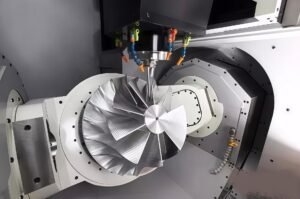
Stainless steel is highly favored across medical, aerospace, and chemical processing industries due to its exceptional corrosion resistance and mechanical strength. However, these identical properties make it notorious for being a difficult-to-machine material. During the cutting process, severe work hardening, high cutting temperatures, and strong tool adhesion often lead to premature tool failure. This technical guide explores advanced techniques for milling, milling strategies, tool metallurgy, and tailored material selection to achieve flawless precision. If you are looking for a reliable manufacturing partner, XML Tech provides world-class CNC turning and milling services to bring your designs to life.
1. Technical Challenges in Stainless Steel Milling
Milling stainless steel presents distinct physical phenomena that complicate material removal:
· High Adhesion & Built-Up Edge (BUE): Stainless steel exhibits high tackiness and thermal welding properties. During machining, chips easily adhere to the cutting edges of the mill, deteriorating the surface finish and accelerating micro-chipping.
· Severe Work Hardening: During conventional up-milling (conventional milling), the cutter teeth slide over the previously machined surface before engaging the cut. This mechanical rubbing drastically increases the work hardening tendency of the sub-surface layer.
· Severe Thermal Shock & Vibration: High cutting forces combined with intermittent contact create heavy impact vibrations, causing thermal fatigue cracks and rapid flank wear on the cutter teeth.
2. Tool Material Selection & Optimized Geometries
To survive the rigorous dynamics of stainless steel milling, milling tools must possess an optimal balance of hot hardness and structural toughness.
2.1 Carbide and High-Speed Steel (HSS) Balancing
While face mills and certain end mills utilize indexable cemented carbide, other complex profile cutters rely heavily on cobalt-bearing or vanadium-enriched high-speed steels (such as tungsten-molybdenum series), which improve tool life by 1 to 2 times compared to standard W18Cr4V. For premium carbide grades, variants such as YG8, YW2, 813, 798, YS2T, YS30, and YS25 offer excellent shock resistance.
2.2 Optimizing Cutter Geometries
· High Helix Angles: Elevating the helix angle (Beta) from 20° to 45° increases the effective working rake angle from 11° to over 27°. For end mills, restricting Beta to 35° or less is recommended to maintain cutting edge strength.
· Wave-Edge Geometries: Deploying wave-edge end mills for machining stainless pipes or thin-walled components reduces vibration, breaks up chips easily, and prevents part distortion.
· Negative Chamfer Mechanics (SWC Cutters): Utilizing silver-white chip (SWC) face mills with a negative chamfer of -30° intentionally generates a controlled built-up edge. This temporary structure acts as the temporary cutting edge, absorbing the main thermal load. Under the influence of the entering angle, parallel thrust forces push the chips out sideways, reducing cutting power by up to 44%.
3. Advanced Kinematics: Climb Milling & Cooling Strategies
3.1 Implementing Asymmetric Climb Milling
In stainless steel milling, milling tool pathways should always utilize climb milling (down milling), preferably asymmetric climb milling. This cinematic approach ensures that the cutter teeth engage the material at the maximum chip thickness and exit smoothly where the thickness is zero.
This minimizes chip adhesion area, allowing centrifugal forces to easily fling the chips away. Consequently, it prevents chips from being trapped under the teeth upon re-entry, eliminating tool face spalling and chipping.
3.2 Advanced Cooling Setup
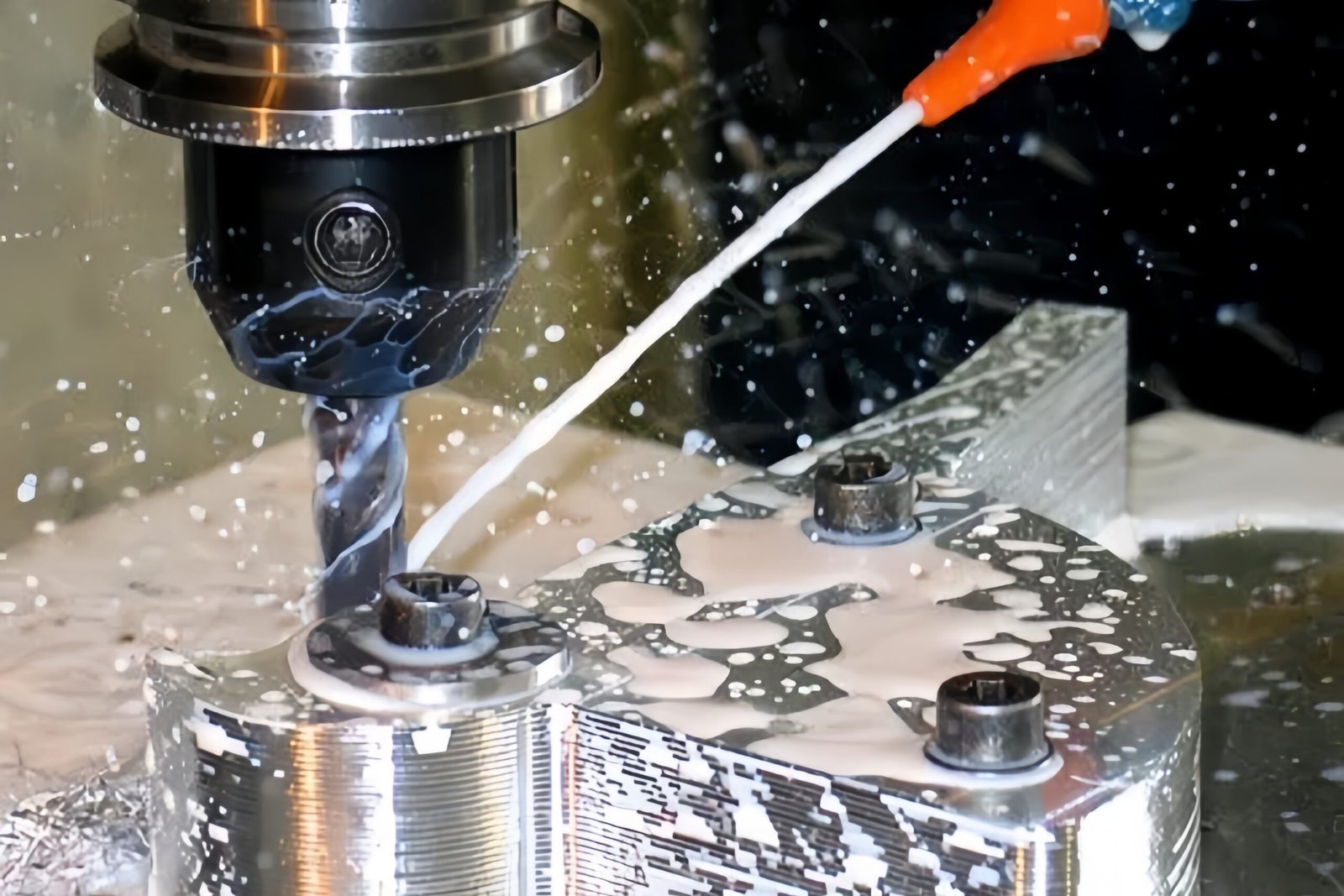
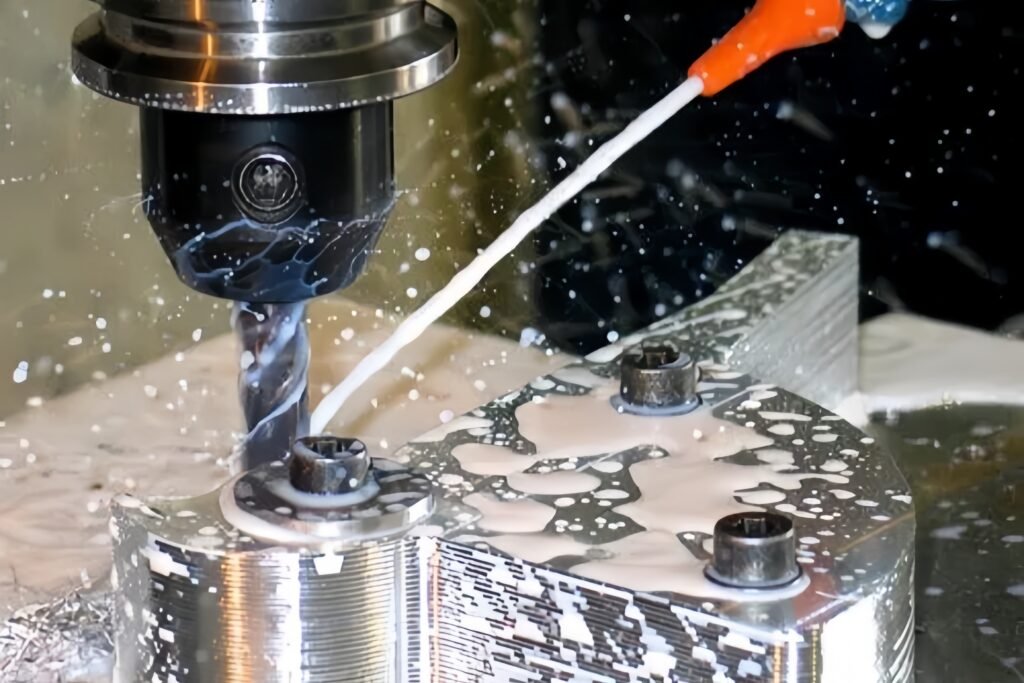
Mist Cooling (Minimum Quantity Lubrication – MQL): This delivers the most significant performance breakthrough, often doubling tool life compared to flood cooling.
Flood Cooling Requirements: If conventional 10% emulsified soluble oil is used, a high-volume, high-pressure pump system must be maintained to guarantee uninterrupted thermal evacuation. For general carbide milling, recommended parameters are: Vc = 70 – 150 m/min and Vf = 37.5 – 150 mm/min, adapted precisely per alloy grade.
4. Stainless Steel Material Selection Guide
Selecting the appropriate stainless steel grade requires a clear perspective of the mechanical environment, operational temperatures, and mechanical stress. At XML Tech, we regularly process these challenging alloys through our precision custom CNC machining capabilities, meeting the exact standards categorized below:
The 300 Series (Austenitic) — General Corrosion Resistance
Type 304 (Standard Austenitic)
Properties: Excellent resistance to general atmospheric corrosion and food processing organic media. However, it is vulnerable to high-temperature concentrated acids and chloride-induced pitting.
Applications: Kitchen & commercial appliances, hospital equipment, consumer goods, and wastewater treatment devices.
Type 304L & 304N (Low-Carbon & Nitrogen-Strengthened)
Properties: 304L offers superior resistance to nitric acid and mid-temperature/mid-concentration sulfuric acid. 304N exhibits remarkable mechanical impact toughness in cryogenic environments.
Applications: Liquid gas storage tanks, cryogenic industrial equipment, and heavy-duty welded components.
Type 316 (Molybdenum-Alloyed)
Properties: Enhanced nickel matrix integrated with 2%–3% Molybdenum. It delivers exceptional resistance to chloride-induced pitting and violent sulfurous compounds.
Applications: Marine hardware, chemical processing valves, pharmaceutical components, and sulfite pulp machinery.
Type 317 (High-Molybdenum)
Properties: Features higher Chromium and 3%–4% Molybdenum compared to 316, providing the highest baseline resistance to severe localized pitting and crevice corrosion.
Applications: Flue gas desulfurization (FGD) systems, aggressive chemical reactors, and petrochemical piping.
The 400 Series (Ferritic & Martensitic) — Aesthetics & High Strength
Type 430 (Ferritic)
Properties: Lower overall alloy content than 304, but capable of achieving high mirror-polish aesthetics in mild atmospheric conditions while resisting mild food organic acids.
Applications: Architectural trim, automotive interior/exterior molding, and mild nitric acid processing equipment.
Type 410 (Martensitic)
Properties: Holds the lowest alloy content among general grades. It is highly heat-treatable to achieve superior mechanical hardness paired with reliable baseline corrosion resistance.
Applications: High-stress structural fasteners, heavy-duty drive shafts, turbine blades, and wear-resistant hardware.
Duplex Series — Ultimate Yield Strength & Stress Resistance
Type 2205 (Austenitic-Ferritic Duplex)
Properties: The dual-phase microstructure delivers roughly twice the mechanical yield strength of 304/316, combined with supreme immunity to chloride stress corrosion cracking (SCC).
Applications: Oil & gas subsea extraction pipelines, marine chemical cargo tanks, high-load pressure vessels, and heat exchangers.
Conclusion
Mastering stainless steel requires deep metallurgical insight, elite rigid tooling setup, and mathematically sound milling, milling parameter optimization. At XML Tech, backed by over 10 years of intensive CNC hardware machining experience and 18 years of high-precision component manufacturing heritage, we have fully standardized the processing protocols for austenitic, ferritic, and duplex stainless steels. Whether your project demands complex 5-axis profiles or ultra-smooth medical finishes, our specialized turn-mill composite services stand ready to deliver.
Looking for high-tolerance stainless steel components? Get a factory-direct quote via our[Custom CNC Turning Machine Parts] page today!