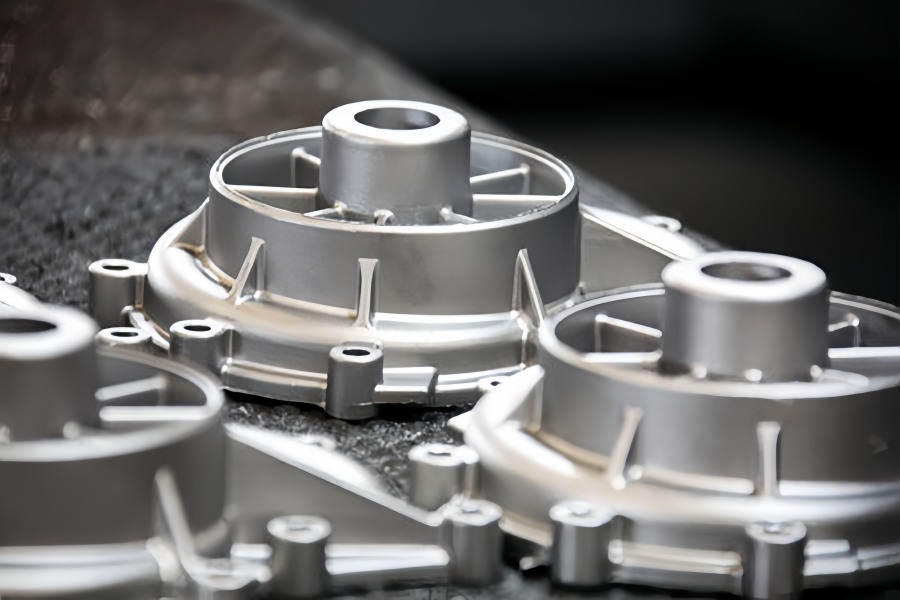
Three quotes come back for the same housing. One prices A380, one prices ADC12, one prices A360. The numbers differ by more than the alloy cost difference explains, and nobody volunteered which one the drawing actually calls for.
That gap is normal in die cast aluminum work, because the alloy is usually specified by whoever wrote the drawing first, and the specification rarely says why. A380 became the default in North America partly through supply habit. ADC12 became the default in Asia through a different standard. A360 exists for a specific reason that most drawings ignore.
This article covers what each of the three alloys does well, where they fail, how wall thickness turns alloy choice into a porosity problem, and what a complete callout looks like. It ends with the machining and finishing question that decides more projects than alloy price does, and the tolerance side of that question sits in our CNC Machining Services scope.
What Die Cast Aluminum Can and Cannot Do
Die cast aluminum makes thin, complex, near-net shapes in one shot. It does not make strong, ductile, heat-treatable parts, and no alloy choice changes that. This boundary is set by the process, not by the metal.
What is die cast metal, in one sentence: aluminum alloy poured into a steel die at high velocity and frozen under pressure. The metal solidifies while it is still moving, so air trapped in the flow stays in the part as porosity. That is why die castings are not usually heat treated to high strength: a T6 cycle on a part full of trapped gas produces blisters on the surface as the gas expands.
What you get instead is dimensional repeatability and surface detail that sand casting cannot approach. A well-built aluminum casting die holds those tolerances across a run of 100,000 shots without rework. Wall sections down to about 1 mm are routine on small parts, and 2 to 4 mm is the working range for structural housings. NADCA’s product specification standards treat those numbers as the practical envelope.
Standalone conclusion: Die cast aluminum buys thin walls, complex geometry, and repeatability; it does not buy ductility or heat-treatable strength, because trapped gas is inherent to high-velocity filling.
A380: The Default and Why It Dominates
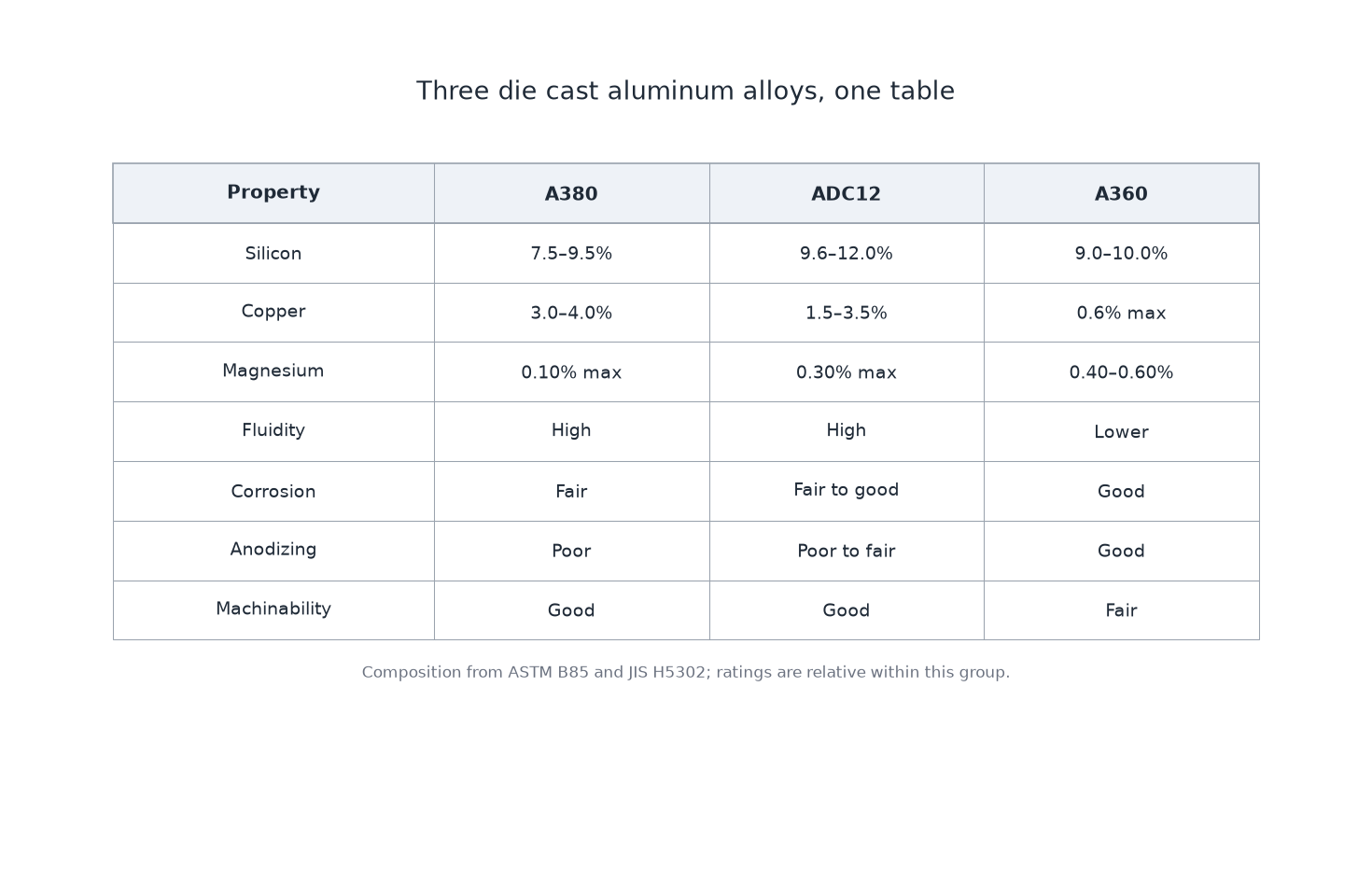
A380 dominates North American die casting because it balances fluidity, cost, and machinability better than any alternative at the same price. Per ASTM B85, it carries roughly 7.5 to 9.5 percent silicon and 3.0 to 4.0 percent copper.
The silicon gives fluidity, which lets the metal fill thin sections before it freezes. The copper gives strength and improves machinability, which is why A380 cuts cleanly and holds a tapped thread well. Those two additions are also why it corrodes more readily than low-copper alloys and why it cannot take a decorative anodized finish.
In practice, an aluminum die casting job specified only as “A380” is a job where nobody made a decision. That is fine for a bracket, a gearbox cover, or an internal frame. It is a problem for anything that lives outdoors, gets anodized, or has to be welded.
Standalone conclusion: A380 is the default because silicon buys fluidity and copper buys machinability, and both additions make it a poor choice for outdoor corrosion or decorative anodizing.
ADC12: The Japanese Equivalent That Is Not Identical
ADC12 is the Japanese aluminum alloy die casting grade, specified under JIS H5302, and it is often described as the Japanese A380. It is close, not identical. The silicon range is wider, 9.6 to 12.0 percent, and the copper range is lower, 1.5 to 3.5 percent.
That lower copper ceiling is the practical difference. A part poured at 2 percent copper behaves differently from one poured at 3.8 percent, even though both are within their respective standards. Corrosion resistance is slightly better, anodized appearance slightly less gray, and strength slightly lower.
Where the copper difference shows up
The difference appears first at the anodizer. High-copper aluminum anodizes to a dark, uneven gray because the copper-rich phases do not convert to oxide the way the aluminum matrix does. A380 at the upper end of its copper range is visibly worse than ADC12 at the lower end of its.
The second place it appears is in machining. Copper improves machinability, so ADC12 at 1.5 percent copper cuts with more built-up edge and needs sharper tools than A380 at 4 percent. A shop that runs both will tell you the tool life differs, and that difference lands in the piece price.
Standalone conclusion: ADC12 and A380 overlap but are not interchangeable: ADC12’s lower copper ceiling gives slightly better corrosion and anodized appearance at the cost of strength and machinability.

A360: Better Corrosion, Worse Fluidity
Choosing die cast aluminum material starts with the service environment, not the datasheet. Three grades cover most of the market, and the table below is the comparison most drawings should have carried.
| Property | A380 | ADC12 | A360 |
|---|---|---|---|
| Silicon | 7.5–9.5% | 9.6–12.0% | 9.0–10.0% |
| Copper | 3.0–4.0% | 1.5–3.5% | 0.6% max |
| Magnesium | 0.10% max | 0.30% max | 0.40–0.60% |
| Fluidity | High | High | Lower |
| Corrosion resistance | Fair | Fair to good | Good |
| Decorative anodizing | Poor | Poor to fair | Good |
| Machinability | Good | Good | Fair |
Composition ranges are from ASTM B85 for A380 and A360, and JIS H5302 for ADC12. A360 trades fluidity for corrosion resistance and ductility. Per ASTM B85 it carries about 9.0 to 10.0 percent silicon, up to 0.6 percent copper, and 0.40 to 0.60 percent magnesium. The magnesium is what improves corrosion performance.
The cost is fill. Lower copper and a narrower freezing range make A360 less fluid than A380, so thin sections that fill reliably in A380 may short-run in A360. Die design has to compensate with larger gates, higher injection velocity, or a thermal profile that keeps the die hotter at the last-to-fill location.
Where A360 earns its premium is outdoor hardware, marine-adjacent parts, and anything that will be powder coated after a conversion coating. A380 in the same service develops white corrosion product at edges and around inserts within a season or two.
Standalone conclusion: A360 buys corrosion resistance and ductility with magnesium, and pays for it in fluidity, so thin-wall parts need die changes rather than a simple alloy swap.

Wall Thickness and the Porosity It Causes
Wall thickness is the largest driver of porosity in aluminum die casting parts, and uniform thickness matters more than thin thickness. A part with a 2 mm wall everywhere casts better than one with a 2 mm wall and a 6 mm boss.
The reason is solidification order. Thick sections freeze last, and by the time they freeze there is no liquid metal left to feed the shrinkage. The result is a shrinkage void in the middle of the boss, invisible from outside and fatal to a tapped hole.
Three rules cover most of it:
- Keep nominal wall between 2 and 4 mm for housings, and taper transitions over at least three times the thickness change.
- Core out thick bosses rather than adding machining allowance, because a cored hole removes the mass that causes the void.
- Put ejector pins and gates on the thick side, so the last metal to freeze is also the metal with the most feed available.
Standalone conclusion: Porosity in die cast aluminum comes from wall thickness variation more than from thin walls, because thick sections freeze last with nothing left to feed them.
Which Alloys Can Be Machined, Anodized, or Welded
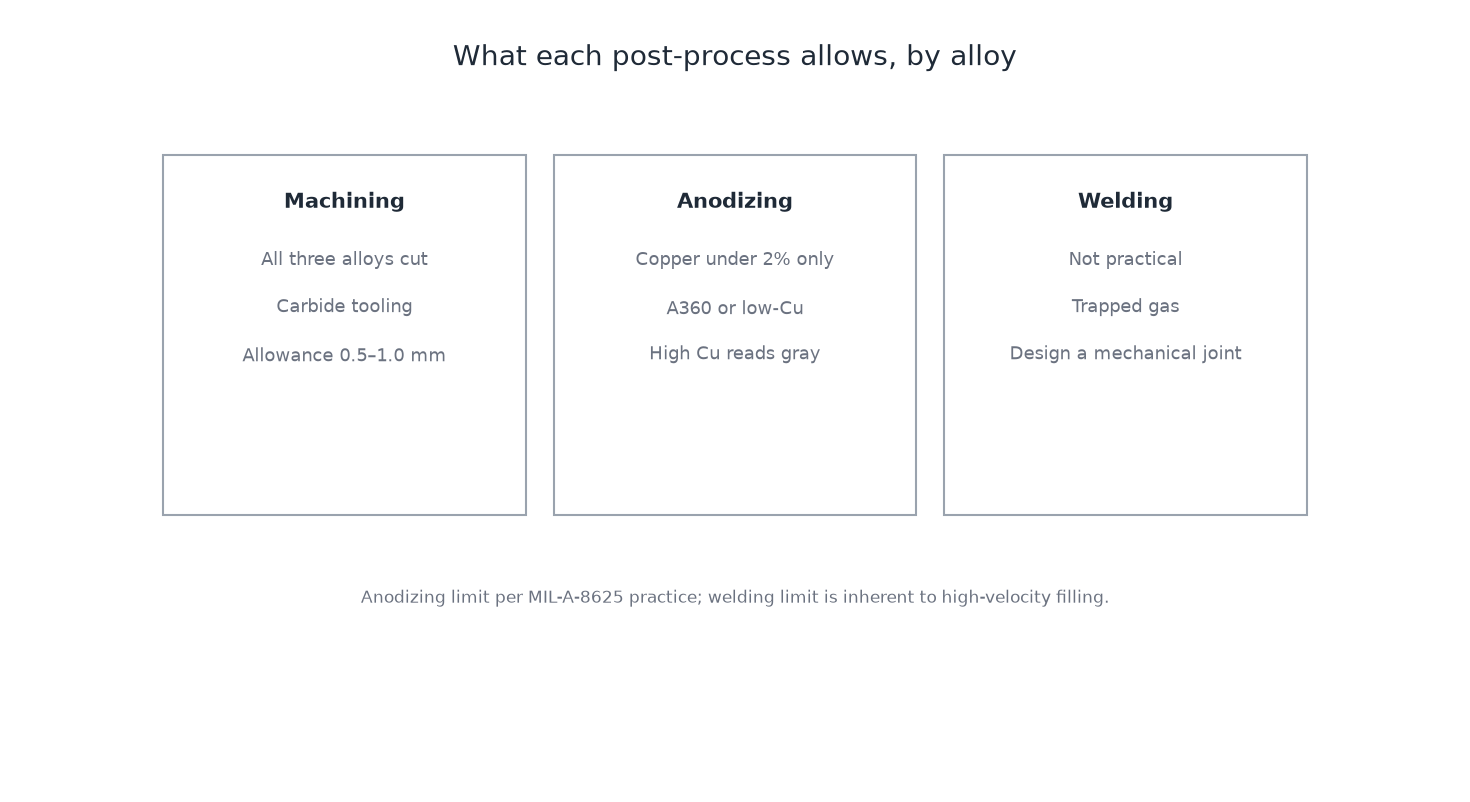
All three alloys machine, none of them weld well, and only the low-copper ones anodize to a usable decorative finish. Knowing which post-process the part needs eliminates alloy options faster than any mechanical requirement.
Machining is the easy one, and all die casting parts machine with conventional carbide. A380 machines most easily because of its copper, ADC12 slightly worse at the low end of its copper range, A360 worst because the lower silicon and copper make it gummier. Die casting machining allowances of 0.5 to 1.0 mm per surface cover most secondary operations.
Anodizing is the constraint. Per MIL-A-8625, sulfuric anodizing on aluminum with more than about 2 percent copper produces a dark, mottled film. If the part must be black or bronze anodized, the alloy has to be low-copper, which points to A360 or a specialized low-copper die casting alloy.
Welding is close to impractical on all three. Die castings contain trapped gas, and welding heats the surrounding metal enough to drive that gas out through the weld pool, producing porosity exactly where you need strength. Design the joint as a mechanical connection or a casting feature instead.
Standalone conclusion: All three alloys machine, high-copper alloys cannot be decoratively anodized, and none of them weld reliably because trapped gas migrates into the weld pool.

Reading an Alloy Callout on a Drawing
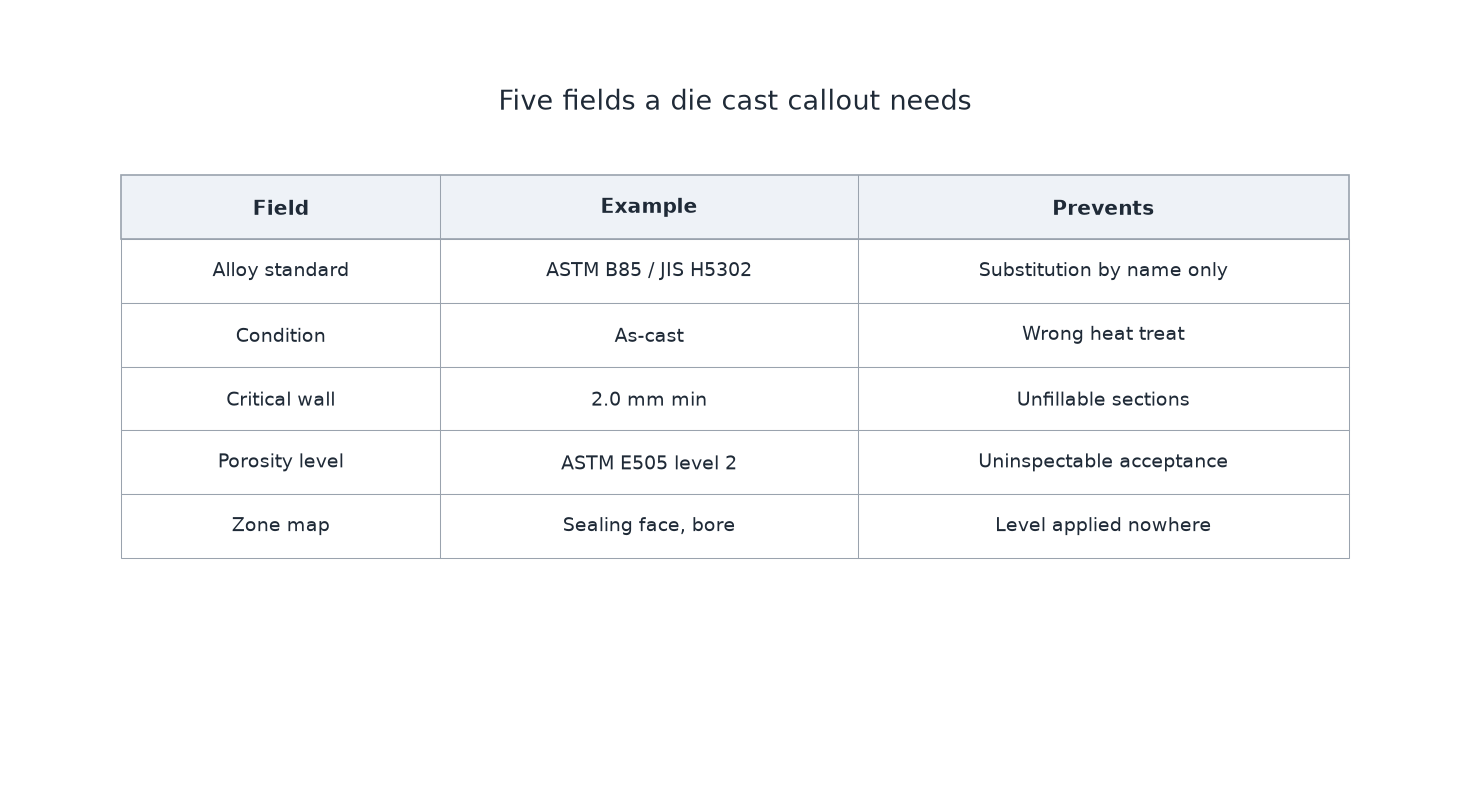
A complete die cast aluminum callout names the alloy standard, the temper or as-cast condition, critical wall thickness, and the porosity acceptance level. A drawing that says only “ADC12” cannot be inspected against, and the argument starts at first article.
The die casting mold and the alloy standard belong in the same block on the drawing, because the two together define what the supplier can and cannot change. The standard reference matters because A380 and ADC12 are not the same document. Call out ASTM B85 for North American supply and JIS H5302 for Asian supply, and if the part will be sourced from both, specify the tighter of the two composition ranges rather than the name.
Porosity acceptance needs a level and a zone. ASTM E505 rates radiographs from 1 to 8, with lower numbers meaning fewer indications, and it distinguishes critical from non-critical areas. “No visible porosity” is not an acceptance criterion; it is an argument waiting to happen.
Our Die Casting Services page lists the alloys and as-cast wall ranges we quote, and the inspection equipment behind those numbers is described on About Us. If you are choosing between alloys for a part that also needs machining, send the drawing through our CNC Machining Quote Form with the service condition and we will flag where the allowance and the porosity risk collide. More process comparisons are collected on the Blog Homepage.
Standalone conclusion: A usable callout names the alloy standard, condition, critical wall, and an ASTM E505 porosity level with acceptance zones — the alloy name alone specifies nothing inspectable.
A380, ADC12, and A360 are three answers to three different questions. A380 answers “make it cheap and machine it well.” ADC12 answers the same question under a different standard, with slightly less copper. A360 answers “make it survive outdoors.”
The variables that decide which one you get are rarely mechanical. Copper content decides whether the part can be anodized. Solidification order decides whether the tapped boss is sound. Wall uniformity decides whether the casting passes radiography on the first try.
If the drawing currently says one alloy name and nothing else, the least expensive next step is to add the standard, the condition, and a porosity level. That takes ten minutes and removes most of the room for a supplier to substitute something that meets the letter of the drawing and none of the intent.