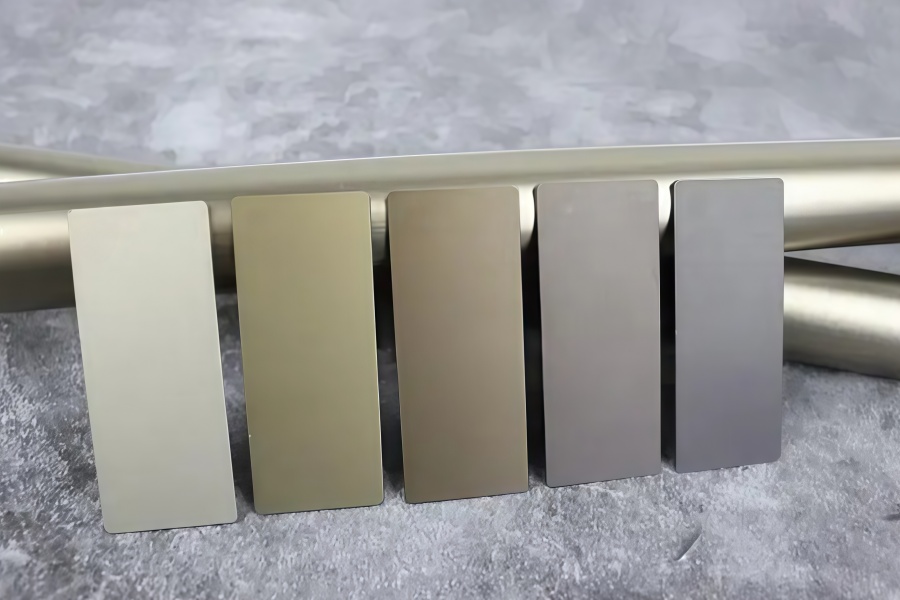
Dark bronze anodized aluminum covers a family of shades, and every finisher has a house version. One shop’s reads almost black under fluorescent light and warm brown in daylight; another’s reads flat gray. No anodized aluminum color chart settles it, because those swatches were made on another alloy in another tank.
The consequence: “dark bronze” alone is not a specification you can reject against. Before any price discussion you need a signed, dated coupon held by both sides. That coupon settles whether a batch is too dark, because both parties compare against the same object rather than against memory, and it converts the question from “is this the right color” into “is this within tolerance of the coupon.”
A second layer catches overseas buyers. Architectural anodized aluminum in the US market tends darker and more neutral, while the same name in some Asian catalogs reads warmer and redder. One step lighter and the naming fragments: brown anodized aluminum, anodized champagne, and gold anodized aluminum all sit adjacent and get confused with it. If your reference is an American storefront and your supplier’s is a domestic sample book, you are not discussing the same color.
Standalone conclusion: Dark bronze is a range rather than a color code, so the first deliverable on any project is a signed physical coupon that defines both the target shade and the acceptable drift around it.
How the Color Is Actually Produced
Three routes reach anodized aluminum dark bronze, and quoting all three at one price is a warning sign.
The first is anodizing dye. The film is immersed in a dye bath and dye molecules lodge in the pores. This gives color anodized aluminum the widest control and the most repeatable results, but lightfastness sets how long it survives outdoors.
The second is integral color, where the bronze comes from alloying elements rather than dye. The shade locks into the oxide and cannot fade, but the range is narrow and the process runs at higher voltage with tighter bath control.
The third is a two-step method: a light dye over an integral or modified film to fine-tune the tone. It buys control at the cost of an operation and another failure point.
Dye, integral color, and the two-step method
The distinction matters most outdoors. A dyed dark bronze on a south-facing facade shifts over years, because dye molecules break down under UV. An integral color holds its tone far longer, because there is no dye to break down.
The tradeoff is flexibility. If your design calls for a bronze that sits between two integral shades, the two-step method is the only way to reach it, and the price reflects that.
Standalone conclusion: Organic dye gives the widest color control but fades under UV, integral color holds its tone but offers a narrow shade range, and the two-step method buys precision at the cost of an extra operation.
The Alloy Decides More Than the Bath Does
The same bath, dwell time, and temperature, applied to 6061 and to 5052, produce two different shades of anodized aluminum dark bronze. This surprises buyers who assume the bath is the variable that matters, and it is why a bronze anodized finish developed on one alloy cannot simply be transferred to another.
Dye uptake depends on pore structure, and pore structure depends on the alloy. Silicon, copper, and grain structure all change how the oxide grows and how much dye it accepts. A high-silicon casting alloy may refuse the dye almost entirely, giving a mottled surface no bath adjustment will fix.
The practical rule is that changing alloy means re-developing the color process, not adjusting it. If a design moves from 6061 to 5052 for cost, or from wrought to cast for geometry, dark anodized aluminum has to be re-sampled. Reusing the old parameters produces a visibly different part, and the difference gets blamed on the finisher rather than on the material change.
Temper matters less than composition but is not neutral. A T6 temper anodizes to a slightly different tone than an O temper of the same alloy, because the oxide grows from a different microstructure. That substrate difference is one of the reasons our CNC Machining Services review asks for the alloy and temper together rather than the alloy alone.
Standalone conclusion: Dye uptake depends on pore structure, which depends on alloy composition, so a material change requires re-sampling the color rather than adjusting existing bath parameters.
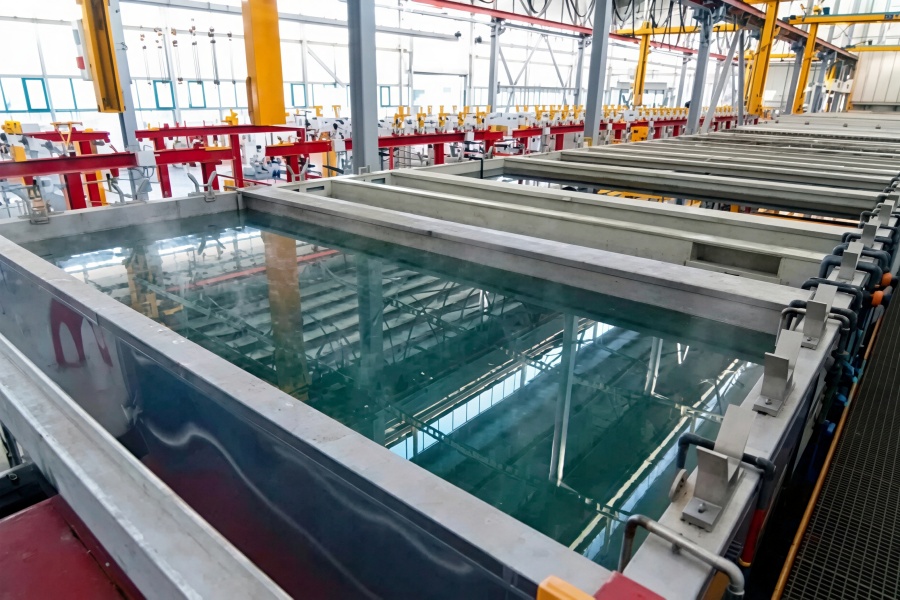
Film Thickness and Why 0.7 mil Changes the Shade
Dye sits inside the pores, so a thicker film holds more dye and reads darker. With anodized aluminum dark bronze this is not subtle — the same recipe at 0.4 mil and at 0.7 mil produces two shades a customer will notice side by side.
The relationship is roughly monotonic. Going from 0.4 to 0.7 mil deepens the tone noticeably. Beyond about 1 mil on a Type II film the gain flattens while brittleness dominates: the film cracks at edges, and cracks show as light lines against a dark surface.
This creates a specification trap. A drawing saying “dark bronze, 0.4 mil minimum” allows 0.4 to 0.8 mil under some standards, and parts at the upper end read visibly darker. Specify both limits, or a nominal with a band tight enough to keep the shade consistent.
Thickness also interacts with the alloy effect above. A high-copper alloy absorbs dye unevenly, and a thicker film amplifies that unevenness instead of hiding it.
Standalone conclusion: Thicker film holds more dye and reads darker, so a minimum-only thickness callout lets shade drift across the batch; specify both limits when color consistency matters.
Batch-to-Batch Drift: The Four Variables That Move
Four variables move the shade between batches. Three are controllable by documentation; the fourth only by material control.
| Variable | Effect on shade | How to control it |
|---|---|---|
| Bath concentration | Weak bath reads lighter, less saturated | Log titrations per shift, not per batch |
| Anodize time | Longer dwell builds thicker film, reads darker | Fixed cycle with in-process thickness check |
| Bath temperature | Warmer bath grows softer film, less dye uptake | Chiller setpoint with alarm band |
| Alloy heat number | Different heats can shift tone slightly | Hold one heat for the whole order |
Concentration drifts as parts run through the bath. Aluminum dissolves into it, acid strength falls, and film grown late in a shift is not film grown at the start. This is behind most complaints about aluminum anodized colors not matching, and logging titrations per shift rather than per batch catches it.
Anodize time is assumed fixed and is quietly variable. A line behind schedule shortens cycles, the film thins, and the parts lighten. Without a cycle record, the shop cannot explain why batch two differs.
Alloy heat number surprises people. Two heats of 6061 that both meet specification can differ enough in trace elements to shift dye uptake visibly. On a color-critical order, holding a single heat for the whole run is the cleanest fix and costs nothing but planning.
Standalone conclusion: Bath concentration, anodize time, temperature, and alloy heat number all shift the shade, and only the first three can be controlled by logging — the fourth requires holding one heat.
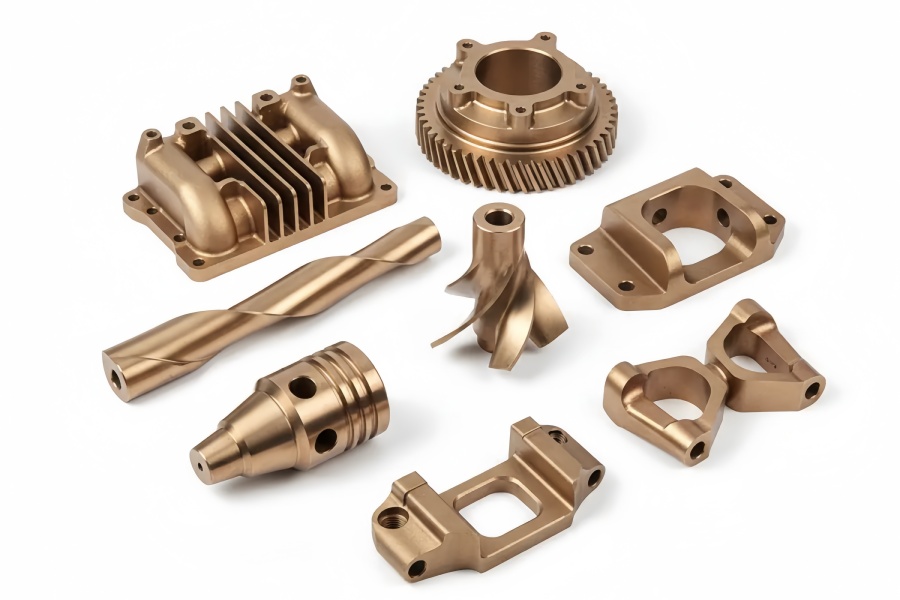
Matching an Existing Part You Cannot Scrap
The most common request is a match to an installed part: a replacement panel, an addition to a facade, a sample approved years ago.
Photographs are useless. The same shade photographs differently under different color temperatures, and the phone’s white balance does the rest. Two photos of one part minutes apart can look like two colors.
Instrument readings are the only transferable reference. A spectrophotometer gives L\*a\*b\* values, absolute numbers independent of the light source. That number can be sent anywhere and means the same thing there.
Order anodized color samples on your own alloy first; a physical sample removes most of the argument. Then the procedure takes five steps:
- Clean the sample with isopropyl alcohol and let it dry, because handling oils shift the reading.
- Take three readings at different points and average them, since anodized color is rarely uniform.
- Record L\*, a\*, and b\*, plus the measurement geometry the instrument used.
- Send the values with the alloy and film thickness of the original, if known.
- Ask for a coupon to approve before the batch runs.
If the original alloy is unknown, say so. A finisher who knows it is a guess can adjust the target for a different substrate; one who assumes 6061 when the part is 5052 will miss in a direction nobody can predict.
Standalone conclusion: Photographs cannot transfer a color, but L\*a\*b\* readings can, provided you also send the alloy and film thickness so the finisher knows what substrate the target sits on.
What to Put on the Drawing So the Next Batch Matches
A callout that leaves nothing to interpretation has six fields. Skipping one hands the decision to whoever runs the line.
The six: standard and type, film thickness range with both limits, color reference, acceptable color difference, sealing method, and masking. A callout reading ANODIZE PER MIL-A-8625 TYPE II, 0.6-0.8 MIL, DARK BRONZE PER APPROVED COUPON, DELTA E 2 MAX, NICKEL ACETATE SEALED is complete. DARK BRONZE ANODIZE is a conversation that repeats next quarter.
The color difference limit is most often omitted and decides disputes. A ΔE around 2 is roughly where an average observer stops noticing a difference side by side. Tighter is expensive; looser than 4 and parts read as different colors on the same wall. ΔE needs a reference, so a signed coupon is the simplest form and L\*a\*b\* values the most portable.
On an assembly with several part numbers carrying the same anodized aluminum finish, specify one coupon for the whole assembly. Two coupons approved on different days will not agree, and the mismatch appears at final assembly where it is most visible.
Our Anodizing Services page lists the film ranges and color capability we hold, and the process data behind it is on About Us. If you have an installed part to match, send it or send the L\*a\*b\* readings through our CNC Machining Quote Form and we will return a coupon before anything enters a bath. More finishing and color guides are on the Blog Homepage.
Standalone conclusion: A complete dark bronze callout names type, a two-sided thickness range, a physical or numerical color reference, a ΔE limit, sealing method, and masking — with one coupon covering a whole assembly.
Anodized aluminum dark bronze is a process with a range, not a product with a code. The shade you get is the product of alloy, film thickness, dye chemistry, and sealing — four variables, each able to move independently between batches.
Three things control it. A signed coupon turns a subjective argument into a measurable one. A two-sided thickness range stops the shade drifting with the film. A ΔE limit defines when a batch is close enough.
None of those costs anything except the time to set them up. The cost of skipping them appears as a rejected lot after the parts are already machined — the expensive place to discover a color problem.