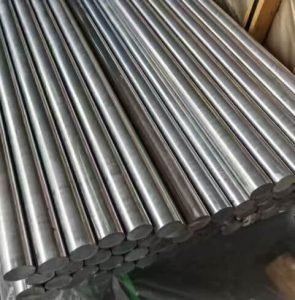
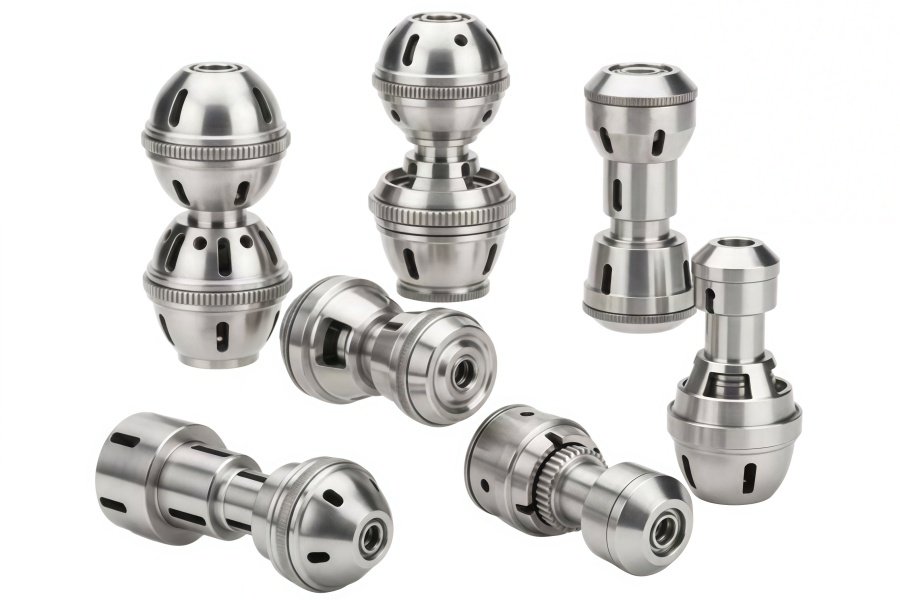
Modern medical device engineering demands unprecedented manufacturing rigor. As Class III implants, spinal fusion systems, endoscopic hardware, and surgical robotic joints evolve, their structural topologies are becoming increasingly intricate. Today’s critical hardware components feature bio-inspired organic freeform surfaces, multi-angled intersecting holes, deep undercuts, micro-sealing geometry, and porous osseointegration lattice structures.
Traditional multi-step manufacturing struggles to meet these demands. With regulatory authorities tightening standards for dimensional tolerances (±0.0025 mm), surface integrity (Ra≤0.4 μm), biocompatibility, and batch-to-batch consistency (Cpk≥1.33), step-by-step repositioning introduces compounding errors and contamination risks. To overcome these barriers, 5-axis CNC machining services have emerged as the essential foundation for manufacturing precision hardware and core components for Complex Medical Devices.
3-Axis vs 5-Axis Machining: Kinematic Principles
Evaluating the necessity of multi-axis cutting requires a deep kinematic and dynamic comparison of 3-Axis vs 5-Axis Machining.
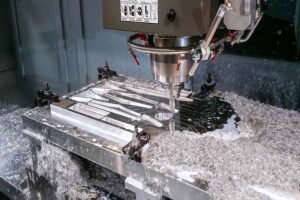
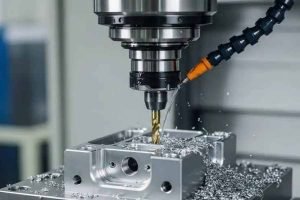
In conventional 3-axis milling, the tool moves strictly along the X, Y, and Z linear axes while maintaining a fixed spatial orientation relative to the workpiece. When machining complex medical parts with compound angles, internal flow channels, or steep contoured surfaces, 3-axis equipment encounters severe physical limitations:
Tool Overhang and Cutting Vibration (Chatter): Machining deep cavities or steep walls on 3-axis machines requires high length-to-diameter (L/D>6) tool extensions. As overhang increases, tool rigidity decreases exponentially, triggering high-frequency chatter. This severely degrades surface roughness (Ra), causes cutter deflection, and accelerates micro-chipping on cutting edges.
Zero-Speed Center-Point Rubbing: When a 3-axis machine uses a ball-nose end mill to machine 3D contours, the cutting velocity at the tip of the ball nose drops to zero. Instead of shearing material cleanly, the tool tip rubs and burnishes the surface, causing severe work-hardening, micro-burrs, and residual stress concentration.
Positioning Errors and Datum Shift: Machining multi-sided complex geometries on 3-axis machines forces operators to rely on custom turnover fixtures and frequent manual setups to re-orient the workpiece.
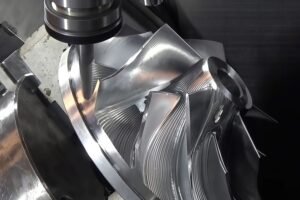
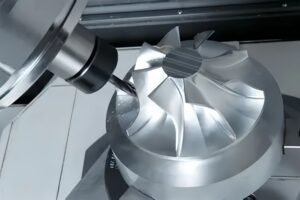
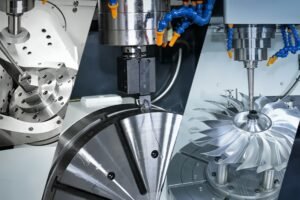
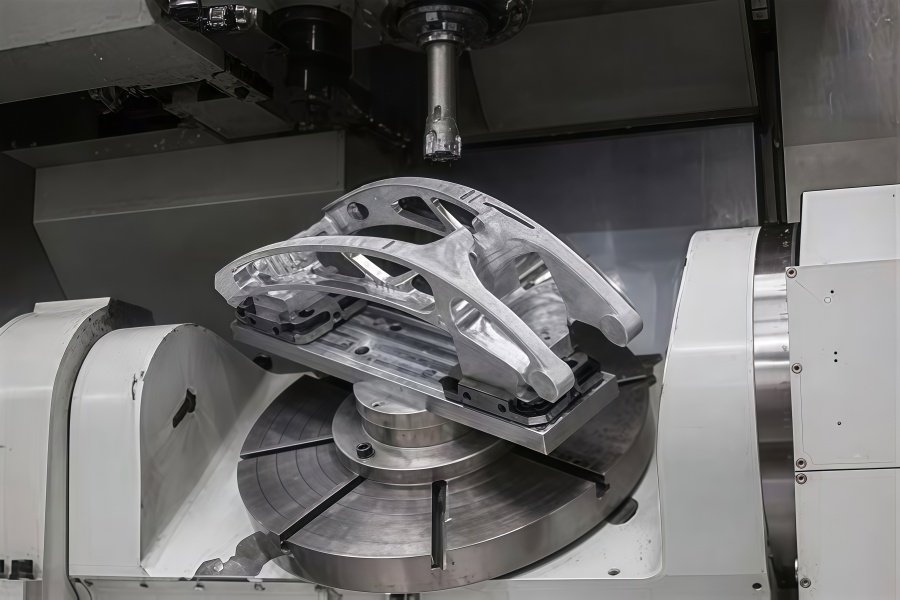
Simultaneous 5-axis machining integrates two additional rotational axes (A/B/C) managed dynamically via RTCP (Rotational Tool Center Point) function in advanced CNC controls.
Key Kinematic Benefits
Optimal Angle of Engagement: 5-axis simultaneous motion continuously adjusts the tool axis relative to the surface normal (maintaining an optimal lead/tilt angle of 15° – 25°). This keeps the cutting zone away from the zero-velocity tip, achieving surface finishes (Ra≤0.4 μm) directly off the machine and eliminating manual polishing.
Minimized Tool Overhang: Rotating the workpiece or spindle head allows short, rigid end mills to reach deep cavities without interference, enabling high-speed, chatter-free milling at sub-micron repeatabilities.
Single-Setup Complete Processing: By executing Setup reduction strategies, 5-axis machines finish 5-sided geometries in one continuous sequence, protecting part accuracy from manual repositioning errors.
The Risks of Multiple Setups in Precision Medical Components
In geometric dimensioning and tolerancing (GD&T) for critical medical hardware, Tolerance stack-up is a primary cause of scrap during volume production.
Medical components—such as surgical gripper housings, cardiac assist pump valve bodies, and orthopedic structural plates—frequently require strict intersecting tolerances:
Coaxiality of angled cross-holes relative to primary mounting datums (≤0.005 mm);
Profile tolerances of compound sealing surfaces across 3D planes;
Positional accuracy of multi-axis mounting features.
When performing multi-step operations on 3-axis mills, each manual fixture change introduces cumulative errors:
Total Positional Error = Fixture Repeatability + Datum Surface Variation + Probing Error + Stress Release Distortion
Even with precision pneumatic workholding, re-clamping introduces positioning variations of 0.003−0.005 mm per setup. Accumulating these variations over 4 to 6 setups causes intersecting features to drift out of tolerance (Tolerance stack-up), leading to sealing failures or alignment errors.
Furthermore, medical components require clean handling. Repeated manual handling exposes parts to surface scratching, clamping damage, and cross-contamination from cutting fluids or airborne particulate matter.
Executing Setup reduction with 5-axis machining consolidates all critical features into a single, uninterrupted clamping cycle. Machining all features under a single unified datum eliminates repositioning drift and preserves the geometric intent of the CAD model.
Process Selection Framework: Swiss Turning vs 3-Axis vs 5-Axis Machining
Optimal manufacturing engineering matches the workpiece’s topological features, length-to-diameter ratio, material properties, and batch volume to the most efficient machine architecture. The three primary subtractive processes for medical hardware are Swiss Turning, 3-axis milling, and 5-axis simultaneous milling.
Swiss Turning Characteristics and Physical Boundaries
Swiss Turning is the gold standard for high-volume production of small, cylindrical, turned components. Its sliding headstock and guide bushing support the bar stock right at the cutting point, preventing workpiece deflection.
Ideal Applications: High length-to-diameter ratio (L/D>5−30) slender rotational hardware, such as bone screws, dental abutments, fixation pins, and flexible endoscopic shafts.
Physical Limitations: Swiss machines are primarily lathe-centric units with live tooling. When faced with non-rotational prismatic enclosures, organic freeform surfaces, deep undercuts, or multi-faceted non-symmetric geometries, Swiss equipment lacks the axis travel, structural rigidity, and dynamic toolpath flexibility required—demanding a shift to 5-axis milling.
Comprehensive Process Decision Matrix
| Evaluation Dimension | Swiss Turning | 3-Axis CNC Machining | 5 axis cnc machining services |
| Primary Topology | Slender rotational shafts, pins, threaded screws | Simple prismatic parts, planar enclosures, flat plates | Complex 5-sided geometry, deep undercuts, freeform surfaces |
| Geometry / L/D Ratio | L/D>5−30, Diameters ≤38 mm | Flat/box geometries without complex compound angles | True 3D spatial complexity, high positional tolerance features |
| Typical Medical Parts | Bone screws, pins, dental abutments, catheter tips | Simple brackets, instrument covers, basic bone plates | Spinal cages, joint housings, robotic surgical arm joints |
| Tolerance Capability | Radial dimensions to ±0.002 mm | Single-plane features ±0.008 mm | Global positional tolerance ≤0.005 mm without stack-up |
| Setup Strategy | 1 setup (Continuous bar feed) | 3 to 6 setups (Frequent flipping & custom fixtures) | 1 setup (Single datum using 5-axis workholding) |
| Economic Volume | High volume (≥1,000 pcs, ultra-fast cycle) | Low complexity / Low volume (<100 pcs) | Medium-to-high volume (100−10,000+ pcs) & custom parts |
Critical Engineering Challenges Solved by 5 axis cnc machining services
When medical hardware components combine complex geometry, challenging materials, and custom patient requirements, 5-axis machining becomes the required manufacturing methodology.
1. Work-Hardening Materials: Controlling Cutting Dynamics in High-Temp Alloys
Implantable components and surgical instruments are fabricated from alloys engineered for strength and biostability. Machining Work-hardening materials presents major thermal and mechanical challenges:
Medical Titanium Alloys (Ti-6Al-4V ELI / Grade 23): Exhibits low thermal conductivity (roughly 25% that of steel), trapping cutting heat at the tool edge, alongside a low modulus of elasticity that causes spring-back and chatter.
Cobalt-Chrome Alloys (Co-Cr-Mo): Extreme Work-hardening materials that undergo instant lattice deformation under high shear stress, causing rapid abrasive tool wear and notch failures.
High-Strength Stainless / Superalloys (17-4PH, Inconel 718): Prone to rapid thermal stress accumulation and strain hardening during cutting.
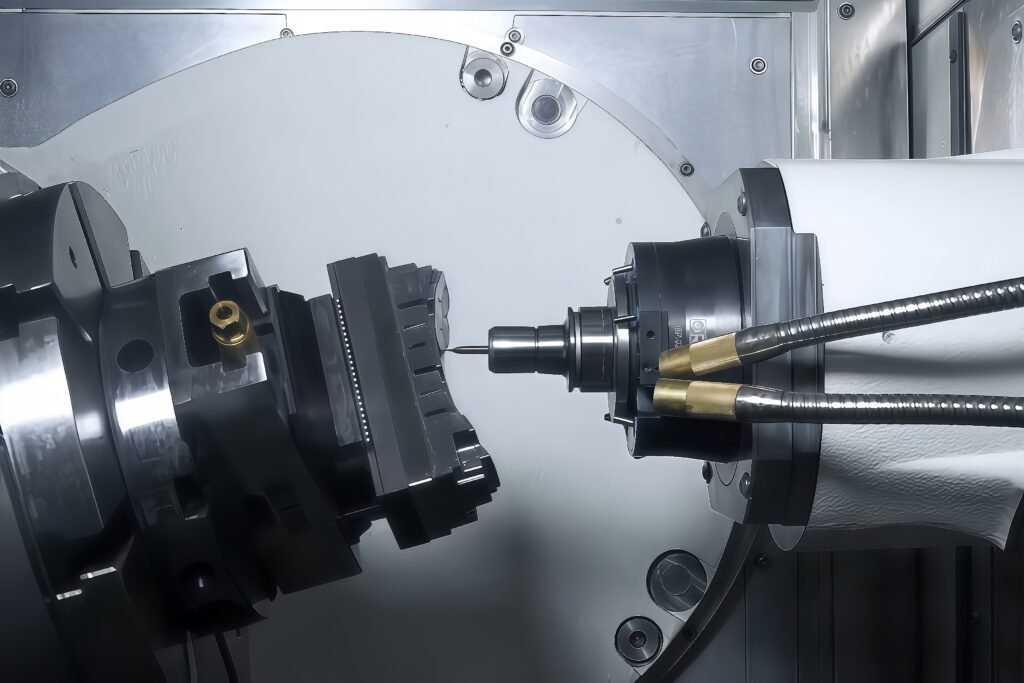
Under fixed 3-axis tool angles, cutters cannot adjust to changes in part curvature, forcing the tool into unfavorable entry angles that accelerate tool wear. Simultaneous 5-axis control continuously adjusts the tool axis relative to the part profile, maintaining optimal chip load to prevent tool rubbing and work-hardening layer formation.
2. High-Precision Processing of Medical-Grade Polymers (PEEK / POM / PTFE)
Beyond metals, 5-axis machining excels in processing medical polymers, such as PEEK spinal cages, cranial plates, and POM-C mechanical linkages:
Thermal Control and Burr Elimination: PEEK (Polyetheretherketone) has low thermal conductivity. Excessive friction causes local melting, gummy surfaces, and heavy burrs along deep cavity edges. 5-axis motion enables smooth toolpaths that rapidly evacuate heat, producing clean, burr-free edges.
Stress Relief: Uniform cutting forces prevent internal stress concentrations, guarding against micro-cracking during subsequent high-pressure steam autoclave sterilization.
3. Patient-Specific Implants: Rapid Flexible Production and Custom Geometry
In personalized healthcare, Patient-specific implants—such as custom cranial reconstruction plates, patient-matched joint pads, and anatomical acetabular cups—require fast turnaround times. These parts feature organic shapes tailored to individual patient CT scan data:
Traditional Manufacturing Limitation: Designing and machining unique 3-axis fixtures for one-off patient designs creates prohibitive lead times and tooling costs.
5-Axis Solution: Utilizing zero-point workholding or self-centering vises, 5-axis machines process Patient-specific implants without part-specific fixtures. CAM software generates 5-axis toolpaths directly from 3D anatomical models, cutting production lead times from weeks to 24–48 hours.
Quantifying the ROI: How Setup Reduction Drives Total Cost Efficiency
Evaluating manufacturing economics purely on machine hourly rates overlooks critical cost drivers. While 5-axis machining centers carry higher machine rates than 3-axis mills, Setup reduction lowers total cost-per-part by 25% to 40% on complex programs.
Sources of Financial Efficiency
Fixture Cost Elimination: Machining a 5-sided part on 3-axis mills requires 3 to 5 custom turn-over fixtures. 5-axis machining relies on a single standardized modular workholding setup, drastically reducing up-front tooling capital.
Labor Reduction: Multi-setup 3-axis processes require manual part repositioning, indicator alignment, and probing routines. 5-axis single-setup operations reduce non-cutting setup times by up to 70%.
Faster First Article Inspection (FAIR): Fewer datum transitions mean fewer inspection steps, streamlining quality validation.
Scrap Rate Reduction: Scrap costs are exceptionally high when working with expensive implant-grade titanium or PEEK. Eliminating manual clamping changes removes the main root cause of operator alignment error.
Production Case Study Comparison (3,000 pcs/year Titanium Endoscopic Joint Housing)
| Production Metric | Traditional 3-Axis Process (5 Setups / 3 Custom Fixtures) | Simultaneous 5-Axis Cell (1 Setup / Modular Zero-Point) | Impact / Performance Delta |
| Number of Setups | 5 Setups (Manual repositioning) | 1 Setup (Complete in-one) | −80% Setup Overhead |
| Machining Cycle Time | 56 minutes | 36 minutes | −35.7% Cycle Time |
| Fixture Investment | $18,500 (3 Custom Fixture Sets) | $3,200 (Standardized Zero-Point System) | −82.7% Capital Outlay |
| First Article Approval (FAIR) | 24 Days | 5 Days | −79.1% Time-to-Market |
| Production Scrap Rate | 7.8% (Primary cause: Datum shifts) | 1.2% (Primary cause: Tool wear) | −84.6% Scrap Cost |
| Total Unit Manufacturing Cost | $162 / Part | $112 / Part | −30.8% Total Cost Reduction |
| Process Capability Index (Cpk) | 1.15 (Critical cross-hole accuracy) | 1.72 (Exceeds strict medical standards) | +49.5% Quality Capability |
Building a Closed-Loop Manufacturing Ecosystem for Scalable Medical Production
Achieving consistent quality across volume production runs under ISO 13485 standards requires an integrated manufacturing cell around the 5-axis machine.
Advanced CAM Toolpath Optimization and Collision Avoidance: Multi-axis continuous toolpaths carry risk of spindle or toolholder collision with the workpiece, machine table, or tombstone. Digital Twin Simulation in advanced CAM software simulates full machine kinematics to verify clearance before sending code to the machine. Adaptive clearing toolpaths maintain a constant tool engagement angle, regulating cutting forces when machining titanium and cobalt-chrome alloys.
Workholding and ISO 13485 Traceability: Modular zero-point clamping bases ensure workpiece positioning repeatability within <0.002 mm across production runs. Under ISO 13485 guidelines, every component maintains complete digital data linkage—including melt heat numbers, machine cell logs, CAM program revisions, in-process probing results, and final CMM reports.
In-Process Metrology and Closed-Loop Control: Integrated infrared probing on the 5-axis spindle enables real-time process adjustments. Probes inspect raw stock location prior to cutting, automatically updating the Work Coordinate System (WCS), while verifying critical dimensions in-process to feed offset adjustments directly back to the CNC control.
Pallet Automation for Lights-Out Manufacturing: Configuring 5-axis machines with 12 to 32-position pallet pool systems enables continuous 24/7 “lights-out” operation. Operators load raw stock and calibrate programs during day shifts, allowing the cell to run unassisted through night shifts to increase spindle utilization.
Primary Medical Application Drivers
5-axis CNC machining services are the established standard across several core medical hardware applications:
Spinal Cages and Interbody Fusion Devices: These parts feature organic lordotic angles matching anatomical spine curves, internal porous lattice structures for bone growth, and angled screw channels. Single-setup 5-sided milling completes the external profile, internal cavities, and angled windows without risking structural damage to delicate porous lattices.
Minimally Invasive Surgical (MIS) Handles and Robotic Joint Modules: These parts contain micro-scale internal channels, narrow clearance slots, and compound angled locating faces on miniature components. Short, small-diameter end mills enter tight features at optimal angles, producing burr-free surfaces for smooth mechanical actuation in surgical robotics.
Joint Replacement Components (Femoral Components & Acetabular Shells): These components require high-precision organic contours (Ra≤0.2 μm) using tough materials like Co-Cr-Mo or titanium. Maintaining tool orientation perpendicular to continuous 3D curves delivers smooth finishes directly off the machine, reducing hand-polishing and preserving exact geometric intent.
Early DFM Integration for Medical Component Manufacturing
Selecting the appropriate process during early design phase dictates project timeline, quality compliance, and total manufacturing costs.
For slender rotational components (such as bone screws or pins), Swiss Turning provides maximum efficiency and throughput.
For simple flat brackets or basic enclosures, 3-Axis CNC Machining offers a cost-effective path.
For components requiring compound angular features, deep undercuts, organic surfaces, tight intersecting tolerances, work-hardening materials (Ti/Co-Cr), or engineering polymers (PEEK), utilizing 5-axis CNC machining services is the definitive strategy to prevent Tolerance stack-up, achieve significant Setup reduction, and minimize unit costs.
To optimize production outcomes, medical device engineering teams should engage manufacturing partners early during the DFM (Design for Manufacturability) stage. Validating tool access, unifying datum references, and optimizing part geometries during early design stages unlocks the full efficiency of 5-axis precision manufacturing, accelerating the transition from prototype development to compliant volume production.
Are you looking for a reliable manufacturing partner for your complex medical hardware components? Our engineering team specializes in producing precision metal and engineering plastic parts to exacting standards. Contact us today for a comprehensive DFM review and request a quote for your next project.