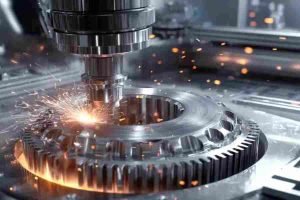
If you’ve ever requested quotes for precision component manufacturing, you’ve likely wondered if 5 axis CNC machining services are worth the premium. For many procurement teams and shop owners, 5 axis CNC equipment is seen as a high-end luxury — reserved only for aerospace primes and elite mold shops, not for day-to-day production work.
But this common belief confuses two very different metrics: the cost of purchasing a 5-axis cnc machine, and the total cost of manufacturing a finished part. While 5-axis hardware certainly commands a higher upfront price, it does not mean every part produced on a cnc 5 axis system will have a higher per-unit cost. For complex, multi-sided, high-tolerance components, 5 axis cnc machining services often deliver a lower total cost by cutting setup labor, reducing scrap, eliminating custom fixturing, and compressing lead times.
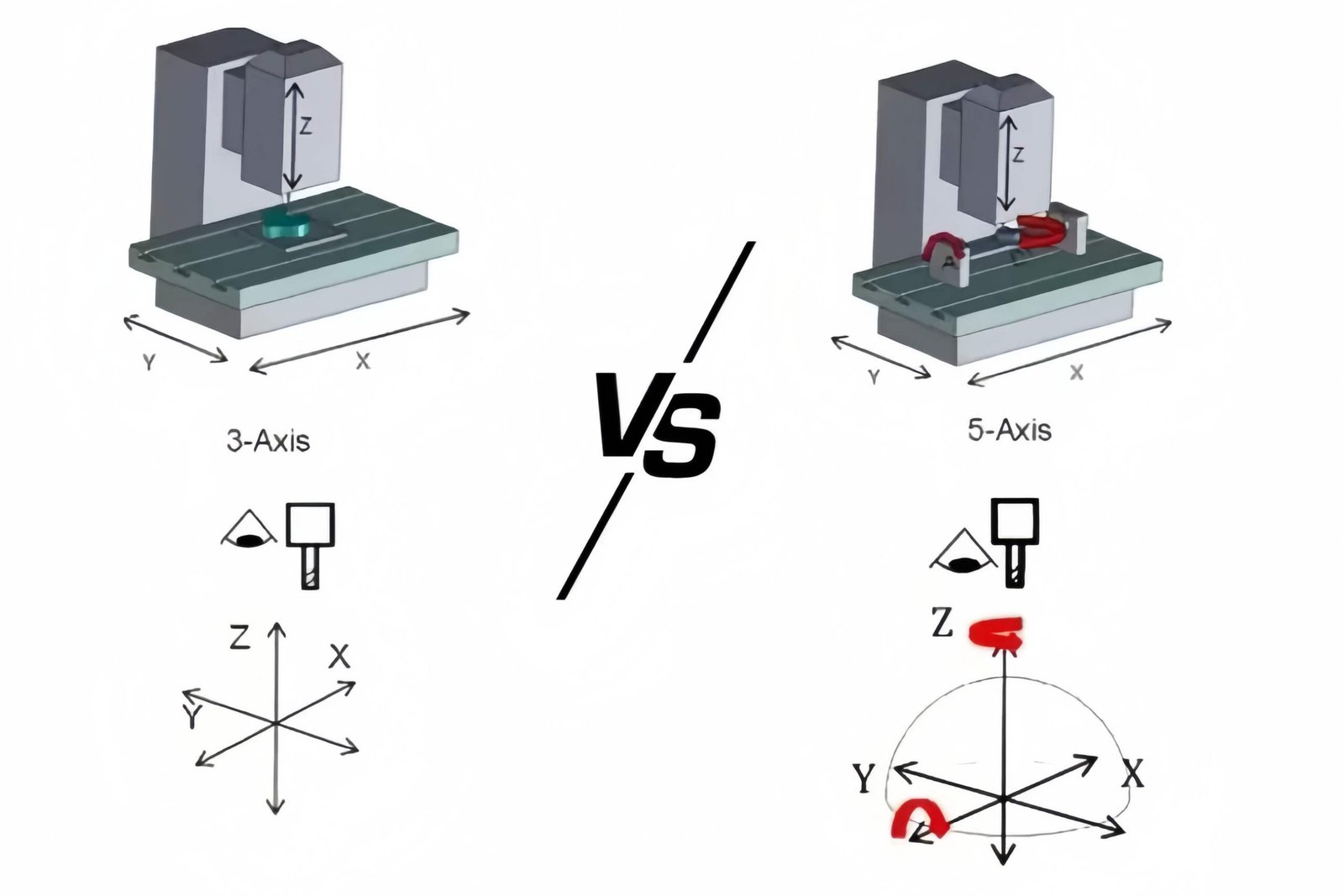
In this guide, we break down the true economics of 3-axis vs 5-axis machining, explain the hidden expenses most quotes overlook, and help you identify exactly when investing in 5 axis capability will reduce your overall production costs.
Why 5 Axis CNC Machines Carry a Higher Upfront Price Tag
The perception that 5-axis machining is expensive is not unfounded. From a capital equipment perspective, a 5 axis cnc machine does cost significantly more than a standard 3-axis vertical machining center. There are clear structural reasons for this price gap.
1.1 Machine Purchase & Depreciation Cost Differences
An entry-level 3-axis CNC mill can be deployed for $50,000 to $150,000, depending on work envelope size and spindle features. A comparable 5 axis cnc mill, by contrast, carries a base price 40% to 100% higher — and full simultaneous 5-axis models routinely range from $250,000 to well over $1 million.
The core components that enable multi-axis motion — high-precision rotary trunnions, tilting spindle heads, linear glass scales, and advanced control systems — add substantial manufacturing cost. When amortized into hourly depreciation, the overhead rate for a 5-axis cnc machine is typically 1.5 to 3 times higher than for a 3-axis machine of equivalent size and build quality.
This hourly depreciation gap is why superficial rate comparisons almost always make 5-axis look more expensive. But hourly machine rate is only one component of total part cost — and often not the largest one.
1.2 Labor & Maintenance Overhead of 5 Axis CNC Equipment
Operating and programming a cnc machine 5 axis system requires a higher skill level than running a standard 3-axis mill. Experienced 5-axis programmers and setup technicians earn 30% to 50% more than their 3-axis counterparts, due to the complexity of multi-axis toolpath planning and the risk of costly collisions or errors.
Maintenance costs also run higher. A 5 axis cnc machine has more moving axes, more complex calibration requirements, and more expensive replacement components. Routine spindle alignment, rotary axis calibration, and control system updates all come at a premium compared to 3-axis equipment.
1.3 When 3-Axis Machining Is Clearly the Cheaper Option
Here’s an honest reality that every 5-axis supplier should acknowledge: for simple parts with features on only one or two sides, 3-axis machining is absolutely the most cost-effective choice.
If you’re machining flat plates, simple blocks, or single-cavity molds that require only a single setup, a 3-axis machine can complete the work faster and at a lower hourly rate. Choosing 5 axis cnc machining services for these straightforward parts is overkill — it will cost more and deliver no measurable benefit in quality or lead time.
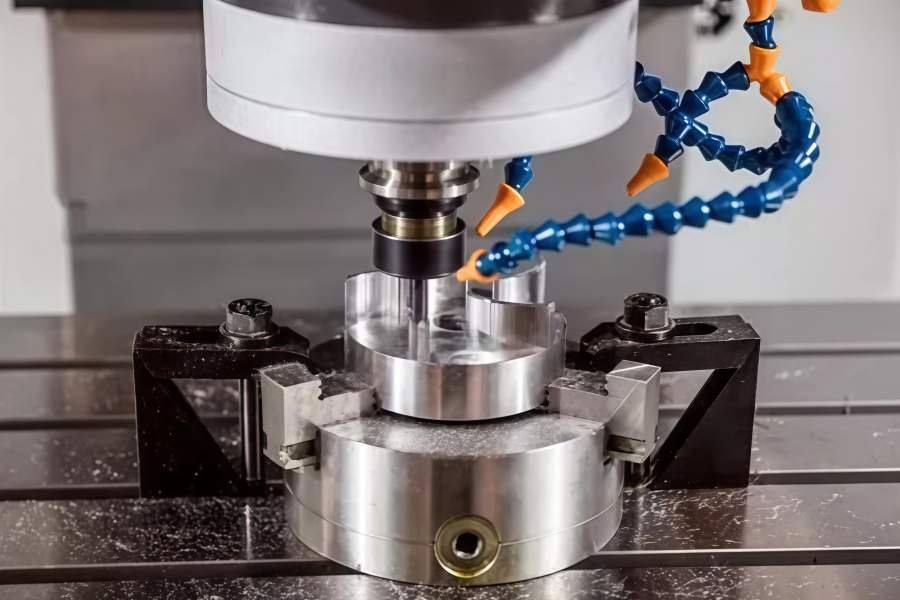
Key takeaway: For simple, single-sided or two-sided parts with loose tolerances, 3-axis machining is cheaper. The value of 5 axis CNC only becomes apparent as part geometry and tolerance requirements grow more demanding.
Hidden Costs That Make 3-Axis More Expensive for Complex Parts
Most buyers only compare hourly machine rates when evaluating quotes. This is a costly mistake. The hourly rate tells you nothing about setup time, number of operations, scrap rates, or fixturing expenses — all of which can dwarf the machining cost itself for complex components.
For parts with angled holes, freeform surfaces, or features across multiple faces, 5 axis cnc machining services deliver lower total cost by addressing these often-overlooked expense categories.
2.1 Fewer Setups Cut Labor & Lead Time on 5 Axis CNC Mills
A 3-axis machine can only cut features perpendicular to the spindle axis. To machine features on multiple sides of a part, an operator must manually flip the workpiece, indicate it in, re-touch off tools, and restart the program. Each additional face adds a complete setup cycle.
For a typical multi-sided housing or manifold with features on 4 to 6 sides, a 3-axis process might require 4 to 6 separate setups. Each setup takes 20 to 45 minutes of skilled labor, plus queue time between operations as jobs move through the shop.
Let’s quantify this with a real-world example: a 100-piece batch of hydraulic valve bodies with machined features on 5 sides.
- 3-axis process: 5 setups per part × 30 minutes per setup = 2.5 hours of setup labor per part. For 100 pieces, that equals 250 hours of setup labor alone. Total production lead time: 3–4 days.
- 5-axis process: A 5 axis cnc mill completes all features in a single clamping. Total setup time for the full batch: roughly 30 minutes. Total production lead time: 8–12 hours.
The direct labor savings are substantial. For low-volume production or prototype work, where setup time
dominates total job cost, the gap is even wider.
Beyond labor savings, fewer setups mean dramatically shorter lead times. In industries where time-to-market is critical — medical devices, aerospace, advanced electronics — compressing delivery from 4 days to 1 day has business value that far exceeds any difference in hourly machining rate.
2.2 Single Setup Reduces Scrap & Tolerance Stackup Errors
Scrap is the single largest hidden cost in precision machining. A single scrapped part can erase the profit margin on an entire batch, especially when working with expensive materials like titanium, Inconel, or medical-grade stainless steel.
Every time you re-fixture a part on a 3-axis machine, you introduce positioning error. These small errors accumulate with each setup, leading to drifted hole positions, out-of-spec perpendicularity, and failed geometric tolerance inspections.
For parts with tolerances tighter than ±0.02 mm, 3-axis machining with multiple setups typically produces a scrap rate of 10% to 20%. For ultra-precision medical implants and aerospace components requiring ±0.01 mm tolerances, scrap rates can exceed 30%.
A cnc 5 axis system machines all features in a single clamping. There is no fixture stackup error, no re-indication variance, and no risk of operator error during part flipping. Geometric tolerances — position, concentricity, perpendicularity — are held consistently and predictably. Typical scrap rates for the same complex parts drop to 1% to 3%.
Let’s put this in financial terms using a titanium aerospace impeller example:
- Material cost per part: $800
- 3-axis machining cost per part: $500
- 3-axis scrap rate: 20% → 20 scrapped parts
- Total 3-axis cost: (100 × $500) + (20 × $1,300) = $50,000 + $26,000 = **$76,000** → $760 per finished part
- 5-axis machining cost per part: $700
- 5-axis scrap rate: 2% → 2 scrapped parts
- Total 5-axis cost: (100 × $700) + (2 × $1,500) = $70,000 + $3,000 = **$73,000** → $730 per finished part
Even with a 40% higher hourly rate, the 5-axis process delivers a lower per-part cost once you account for scrap. This calculation doesn’t even include rework costs, delayed delivery penalties, or customer dissatisfaction — expenses that can easily run into tens of thousands of dollars.
2.3 Eliminating Custom Fixturing Lowers Total Project Cost
Complex 3-axis jobs almost always require custom fixturing. Hard jaws, tombstone fixtures, and dedicated locating pallets must be designed, machined, and qualified before production can begin.
A single set of custom fixtures can cost anywhere from $1,500 to $15,000 or more, depending on part size and complexity. For low-volume jobs — 10 pieces, 5 pieces, or a single prototype — fixturing cost can exceed the actual machining cost.
Fixturing also adds lead time. Designing and building a custom fixture typically takes 3 to 10 business days, delaying the start of production. And if the part design changes, the old fixture becomes obsolete and you have to start over.
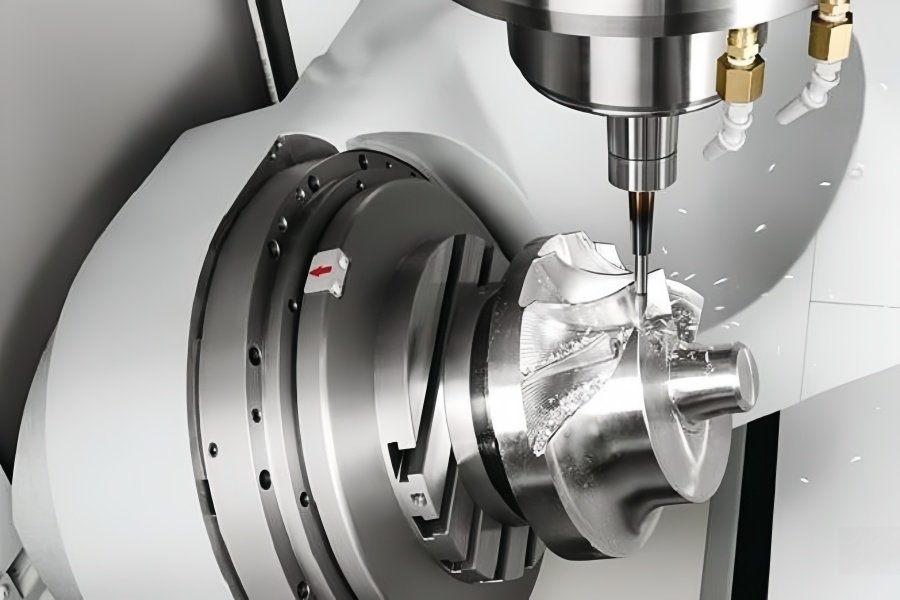
A cnc machine 5 axis system, with its ability to rotate and tilt the workpiece, eliminates the need for most custom fixturing. Most parts can be held in a standard vise, chuck, or vacuum chuck — no dedicated tooling required. This not only saves thousands of dollars in fixture costs per job, but also cuts days or weeks from the project timeline.
This is especially valuable for new product development and custom engineering projects, where design iterations are frequent and speed is critical.
Cost Comparison: 3-Axis vs 5 Axis CNC Machining Services
To help you quickly evaluate which process makes sense for your application, we’ve summarized the cost differences across common component categories.
| Part Type | 3-Axis Cost Drivers | 5-Axis Cost Drivers | Total Cost Verdict | Recommended Process |
|---|---|---|---|---|
| Simple plate / block / single cavity | Low hourly rate, single setup, no custom fixturing | Higher hourly rate, unused capability | 3-axis is 30–50% cheaper | Standard 3-axis VMC |
| Two-sided prismatic parts | One flip, simple fixturing, low scrap risk | Higher hourly rate, minimal setup savings | 3-axis is 10–20% cheaper | Standard 3-axis VMC |
| Multi-sided housing (3+ faces, holes) | Multiple setups, higher labor, basic fixturing | Single setup, no custom fixturing | 5-axis is 5–15% cheaper | 3+2 positional 5-axis |
| Complex freeform surface / impeller / blade | Multiple setups, high scrap, advanced fixturing | Single setup, simultaneous cutting, low scrap | 5-axis is 15–30% cheaper | Full 5-axis simultaneous |
| Ultra-precision medical / aerospace parts | Very high scrap rate, precision fixturing, inspection | Single setup, stable accuracy, in-process inspection | 5-axis is 20–40% cheaper | High-precision 5-axis |
3+2 vs Full Simultaneous: Not All CNC 5 Axis Machines Cost the Same
When people hear “5 axis cnc,” they often picture the most expensive, high-end simultaneous 5-axis machines. But the reality is that over 70% of 5-axis machining applications don’t require full simultaneous motion. Understanding the difference between the two main types of cnc 5 axis technology is the key to getting the capability you need without overpaying.
4.1 3+2 Positional 5 Axis CNC: Affordable Multi-Sided Machining
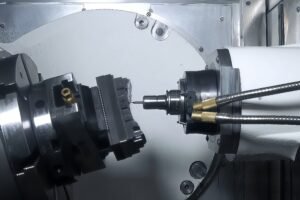
3+2 machining, also called indexed or positional 5-axis machining, uses the two rotary axes to rotate and tilt the workpiece to a fixed angle. Once positioned, the machine cuts in standard 3-axis mode — the rotary axes do not move during the cutting operation.
A 3+2 5 axis cnc machine is much more affordable than a full simultaneous 5-axis system, both to purchase and to operate. Hourly rates are typically 30–40% lower than full 5-axis rates, yet still deliver 90% of the benefit for most multi-sided parts.
For pump housings, valve bodies, mold inserts, and any part with features on multiple faces but no complex 3D surfaces, 3+2 5-axis delivers outstanding value. It’s the most cost-effective way to reduce setups and improve accuracy without paying for full simultaneous capability you don’t need.
4.2 Full Simultaneous 5-Axis: For Complex Freeform Surfaces
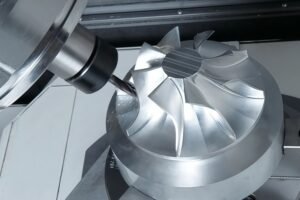
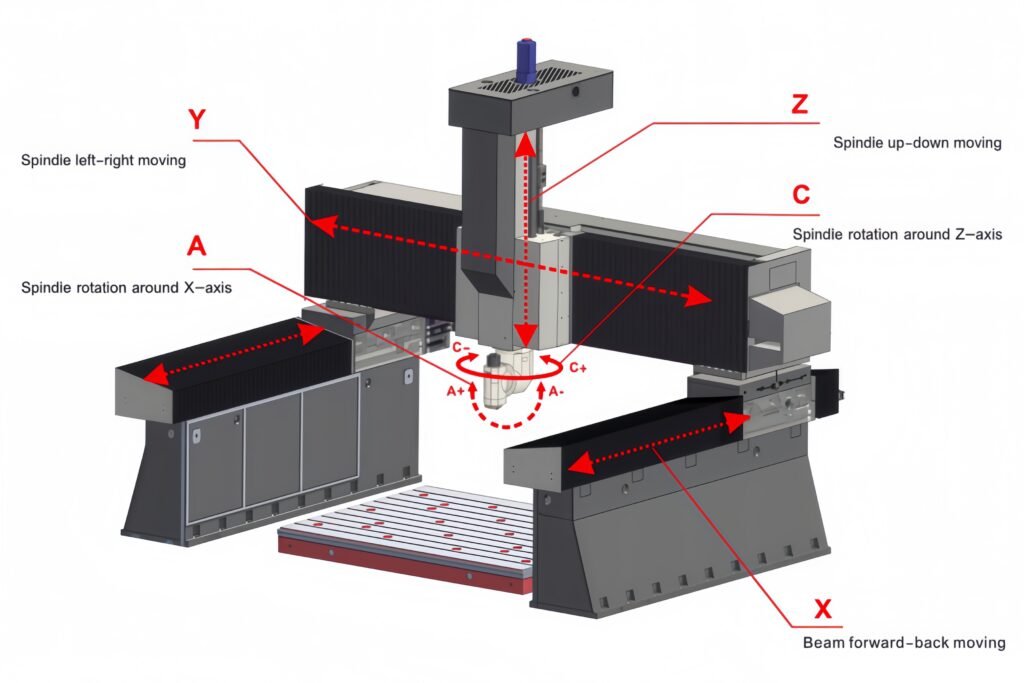
Full simultaneous 5-axis machining means all five axes — X, Y, Z plus two rotary axes — move concurrently during cutting. This allows the tool to follow complex 3D toolpaths, making it essential for machining freeform surfaces like turbine blades, impellers, orthopedic implants, and contoured mold cavities.
As expected, full simultaneous 5 axis cnc machining services come at a premium. The machines are more expensive, programming takes longer, and the process requires more skilled labor.
Practical tip: When requesting quotes for 5 axis cnc machining services, ask your supplier whether your part requires full simultaneous motion or can be run on a 3+2 machine. Many shops default to quoting full 5-axis out of habit, even when a 3+2 machine can do the job faster and at a lower cost.
Quick Check: Is a CNC Machine 5 Axis Right for Your Part?
You don’t need to be a manufacturing engineer to figure out if 5-axis makes sense for your project. Ask yourself these four simple questions to get a clear direction.
5.1 How Many Machined Faces Does Your Part Have?
If your part only has features on one or two sides, 3-axis machining will almost always be cheaper. The more faces and angled features your part has, the more value a cnc machine 5 axis system delivers. As a general rule, parts with 3 or more machined faces start to favor 5-axis economics.
5.2 Are Tight Geometric Tolerances Required?
If your tolerances are looser than ±0.05 mm, multiple 3-axis setups will probably be accurate enough. If you need position tolerances under ±0.02 mm, or critical concentricity or perpendicularity requirements, multiple setups will introduce too much stackup error. 5-axis single-setup machining is the more reliable — and often cheaper — option.
5.3 Will 3-Axis Need Expensive Custom Fixturing?
Estimate the cost of custom fixtures for a 3-axis process. If fixturing will cost more than 10% of the total job value, get a 5-axis quote. In most cases, the 5-axis price will be equal or lower, and you won’t have to wait for fixtures to be designed and built.
5.4 Is This Low-Volume or Prototype Production?
5 axis cnc machining shines in low-volume, high-mix, and prototype environments. The elimination of custom fixturing and setup time more than makes up for the higher hourly rate. For high-volume production of simple parts, the economies of scale favor dedicated 3-axis production cells.
Long-Term Value of Investing in 5 Axis CNC Machining Capability
The cost comparison doesn’t end with per-part price. Choosing 5 axis cnc machining services also delivers strategic long-term benefits that improve your overall competitiveness and profitability.
Access to Higher-Value Markets
Parts with complex geometry — aerospace components, medical implants, high-end motorsports — almost always require 5-axis capability. Adding 5 axis CNC to your supply chain lets you bid on higher-margin work that your competitors can’t touch, opening up new revenue streams.
More Consistent Part Quality
Single-setup machining produces parts with far better consistency from piece to piece. There’s less variation between batches, fewer inspection failures, and lower risk of field failures. This translates to higher customer satisfaction, fewer returns, and stronger long-term client relationships.
Faster New Product Introduction
When you’re developing a new product, speed is everything. 5-axis machining lets you go from CAD file to finished prototype in days, not weeks. No fixture design, no multiple operations — just load the blank and run the program. This accelerated timeline lets you iterate faster, beat competitors to market, and secure design wins.
Final Verdict: When 5-Axis Machining Saves You Money
So, is 5-axis machining always more expensive than 3-axis machining? The answer is a clear no.
It’s true that a 5 axis cnc machine costs more to buy and maintain than a 3-axis machine. But that higher machine cost does not translate to higher per-part costs for every job.
For simple, flat, single-sided parts, 3-axis machining is still the clear winner. For complex, multi-sided, high-tolerance parts, however, 5-axis machining almost always delivers a lower total cost when you account for setup labor, scrap, fixturing, and lead time.
The biggest mistake manufacturers make is judging 5-axis solely by its hourly rate. Smart buyers look at total delivered cost — and that’s where 5-axis consistently comes out ahead.
Get a Free Cost Analysis for Your 5 Axis CNC Machining Project
Still not sure whether 3-axis or 5-axis is the best fit for your next project? Send us your CAD files and drawing specifications. Our experienced process engineers will review your part, evaluate both 3-axis and 5-axis manufacturing strategies, and provide a detailed, side-by-side cost comparison — free of charge.