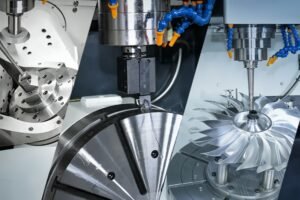
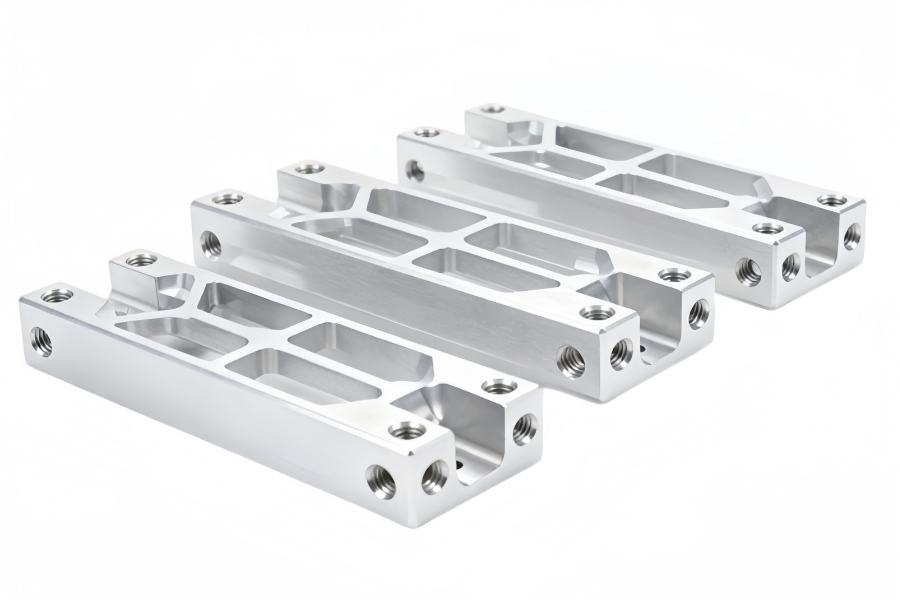
How much does CNC machining cost, and why does the same drawing come back at three different prices? Buyers ask that question on day one and rarely get a straight answer, because the number on a quote is not a rate. It is a sum of five inputs, and each input moves for its own reason.
This article takes the CNC machining cost structure apart in the order the money accumulates. It covers the hourly rate a shop charges, the setup cost that sits above it, how material choice shifts the total between aluminum and stainless, and where the price stops responding to negotiation.
No rate card appears here, and no percentages. Shop rates vary by region, by machine, and by how full the order book is. What holds across all of those is the structure, and structure is what a buyer can actually use.
By the end you will be able to read a quote line by line, name the input that is out of line, and ask a shop a question it has to answer with a specific change rather than a discount.
What a CNC machining cost breakdown actually contains
Every figure on a quote traces back to one of five items. Shops compute them in different order and label them differently, but the set does not change.
Material, priced from the blank rather than the finished shape. Machine time, meaning cycle time multiplied by the shop’s hourly rate. Setup, a fixed block charged once per run rather than once per part. Quality burden, the inspection and documentation the drawing forces. Commercial overhead, covering freight, packaging, and the risk allowance every shop carries.
Five items, not fifty. When a CNC machining cost estimate looks high, one or two of these are carrying the load. Finding out which one is the whole job of quote review.
A note on what a quote is not. It is not a guess about how difficult a part looks. It is an arithmetic result, and every line on the page traces back to one of the five items above.
CNC machining hourly rate: what it pays for and what it does not
The hourly rate is the number buyers fix on first, and the number they most often misread. It is not a shop’s profit per hour. It is a loaded rate that has to cover the machine, the floor space, the tooling consumed, the operator, the programming time behind the job, and the electricity.
Two consequences follow.
A higher rate can produce a lower price. A shop running a newer machine charges more per hour and finishes the part in fewer hours. The product of rate and time can land below a shop with an older machine and a lower rate. Comparing rates across shops without comparing cycle times tells you nothing.
The rate is not negotiable in the way buyers expect. Asking a shop to cut its rate asks it to lose money on every hour the job occupies its floor. Asking it to reduce the hours the job occupies is a technical conversation the shop can win too, which is why it goes somewhere.
What a buyer can influence sits upstream of the rate. Fewer setups, fewer operations, and features the machine can reach in one grip all reduce hours. None of them change the rate, and all of them change the total.
If you want the rate itself in context, ask for the machine the job will run on and the cycle time quoted for it. Most shops will name both. A shop that will not is either unsure or marking up in the dark, and either answer is useful to know before the PO.
CNC setup cost: the fixed block that decides low-volume pricing
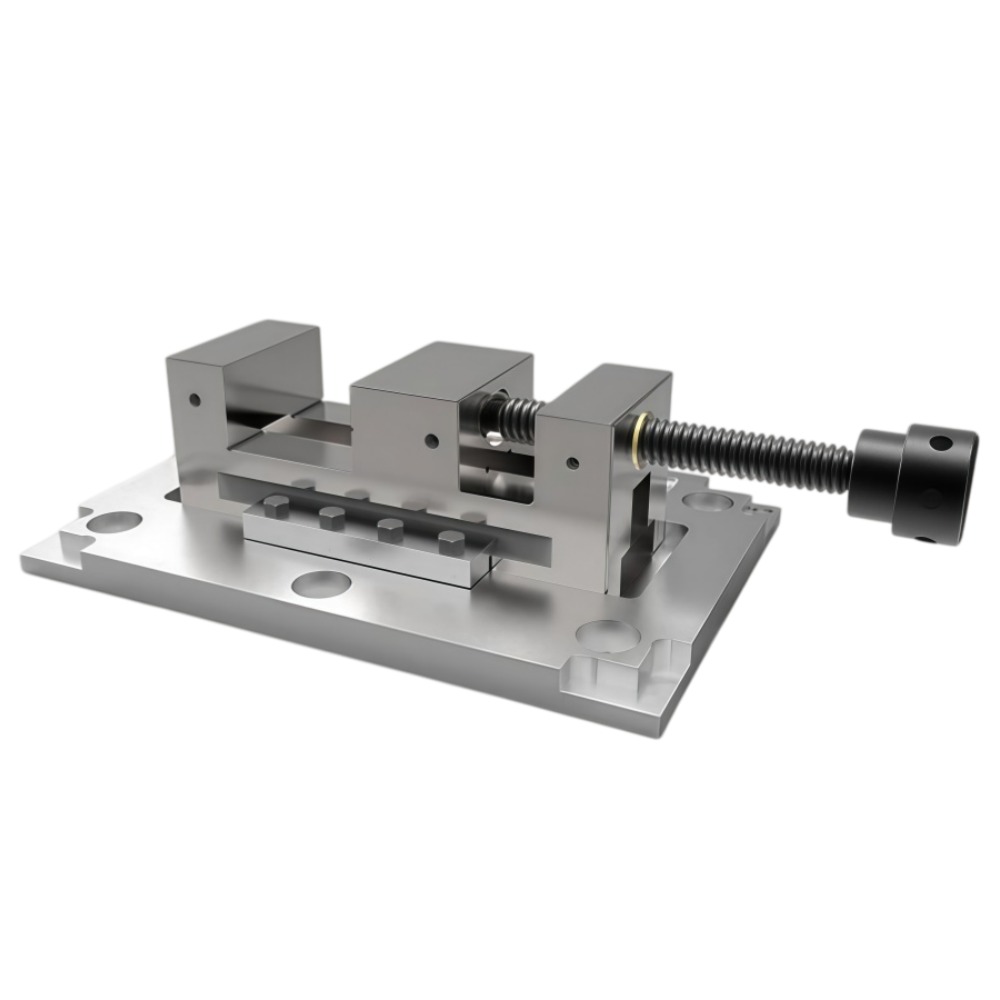
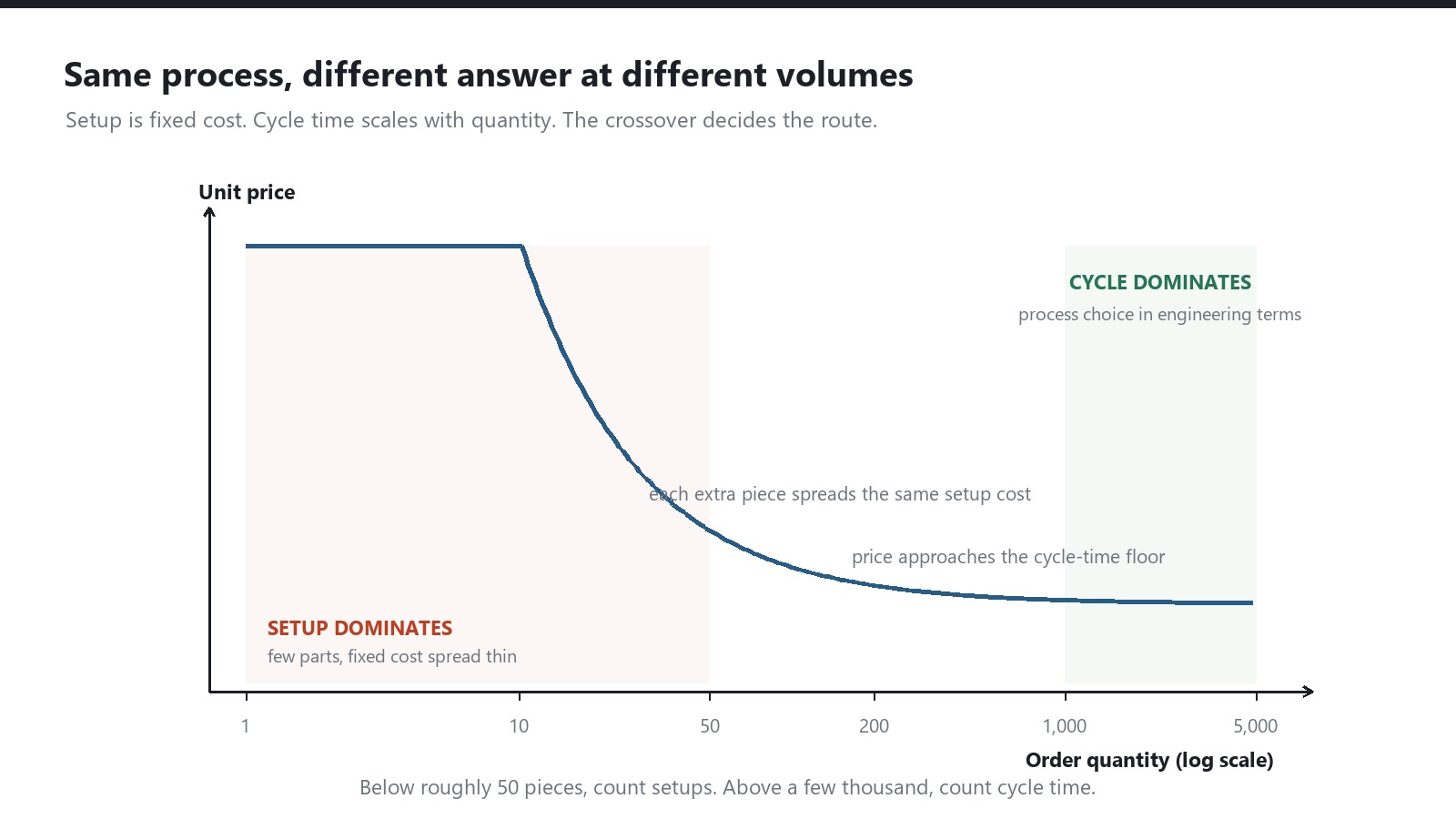
Setup cost is the line buyers ask about least and pay for most at low quantity. It covers programming, fixturing, proving out the first part, and running the first article. All of it happens once per production run, regardless of how many parts follow.
That single fact produces the most misunderstood behaviour in machining pricing. Spread the setup block over five parts and each part carries a large share of it. Spread it over five hundred and the share becomes small. Cycle time, by contrast, scales with quantity almost linearly.
So a five-piece quote and a five-hundred-piece quote should never be compared as unit prices. “Your price per part is high” is an incomplete sentence unless the quantity travels with it.
Two design decisions shrink the block more than any negotiation.
Fewer orientations. Each additional orientation means another fixture, another alignment, another first-piece check, all producing no extra parts.
Fewer distinct parts per drawing set. Where four part numbers share a family, one setup can sometimes serve all four with a modular fixture. Where each is designed alone, each pays its own block.
The useful question is not where the volume crossover sits. It is how many hours of setup are in this quote, and what single change would remove one of them. Shops answer that readily, because it is technical rather than commercial.
CNC machining cost aluminum vs stainless: why material choice moves the total
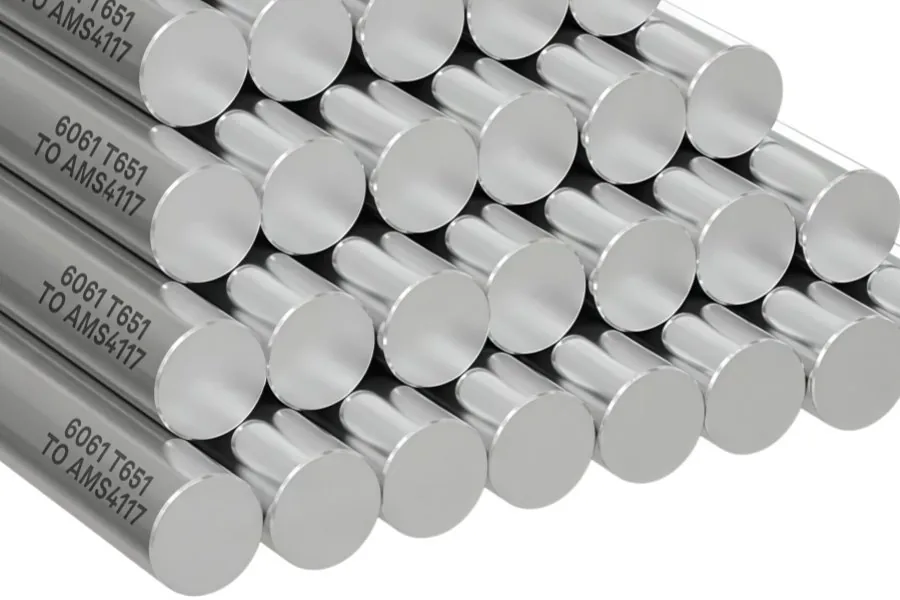
Material choice changes the CNC machining cost in two places, and buyers usually think only about the first.
The stock price. Aluminum bar and stainless bar sit at different points on the metal market, and the gap is structural rather than seasonal. A change from one to the other reprices the blank before a single cut is made.
The machining behaviour. The second effect is larger and less visible. Aluminum cuts freely, allows aggressive parameters, and produces long chips that clear easily. Austenitic stainless work-hardens under the cutter, holds heat at the edge, and demands lower parameters and more tool changes. The result is more machine hours for the same geometry, and machine hours are the second-largest input in the breakdown.
There is a third effect on the finishing side. Stainless frequently needs passivation after machining to restore corrosion resistance at the cut surfaces, and that is a separate operation outside the machining cell. Aluminum usually goes to anodizing or a conversion coating, which is a different cost line again.
The practical implication is that material substitution is never a straight comparison of two stock prices. Moving a part from stainless to aluminum can reduce the machined cost meaningfully. Moving it the other way adds both stock cost and hours. For the metallurgical background on why stainless behaves as it does at the cutting edge, the article on machining stainless steel goes deeper, and the 6061 vs 7075 comparison covers the aluminum side.
Where the CNC machining price can move, and where it cannot
The CNC machining price responds to some inputs and ignores others. Knowing which is which saves review time.
The price moves when you change volume, because setup amortizes. It moves when you reduce the number of setups, because a fixed block shrinks. It moves when you relax a tolerance that no function needs, because the route gets shorter and the inspection burden drops. It moves when you pick a material that cuts faster.
The price does not move much when you argue about the hourly rate, because the rate is the shop’s cost of being open. It does not move when you ask for a discount on a five-piece order, because setup is already the dominant term and there is nothing to discount. It does not move when you send the same drawing to ten shops and pick the ninth, because the ninth is quoting the same structure.
CNC milling cost vs CNC turning cost
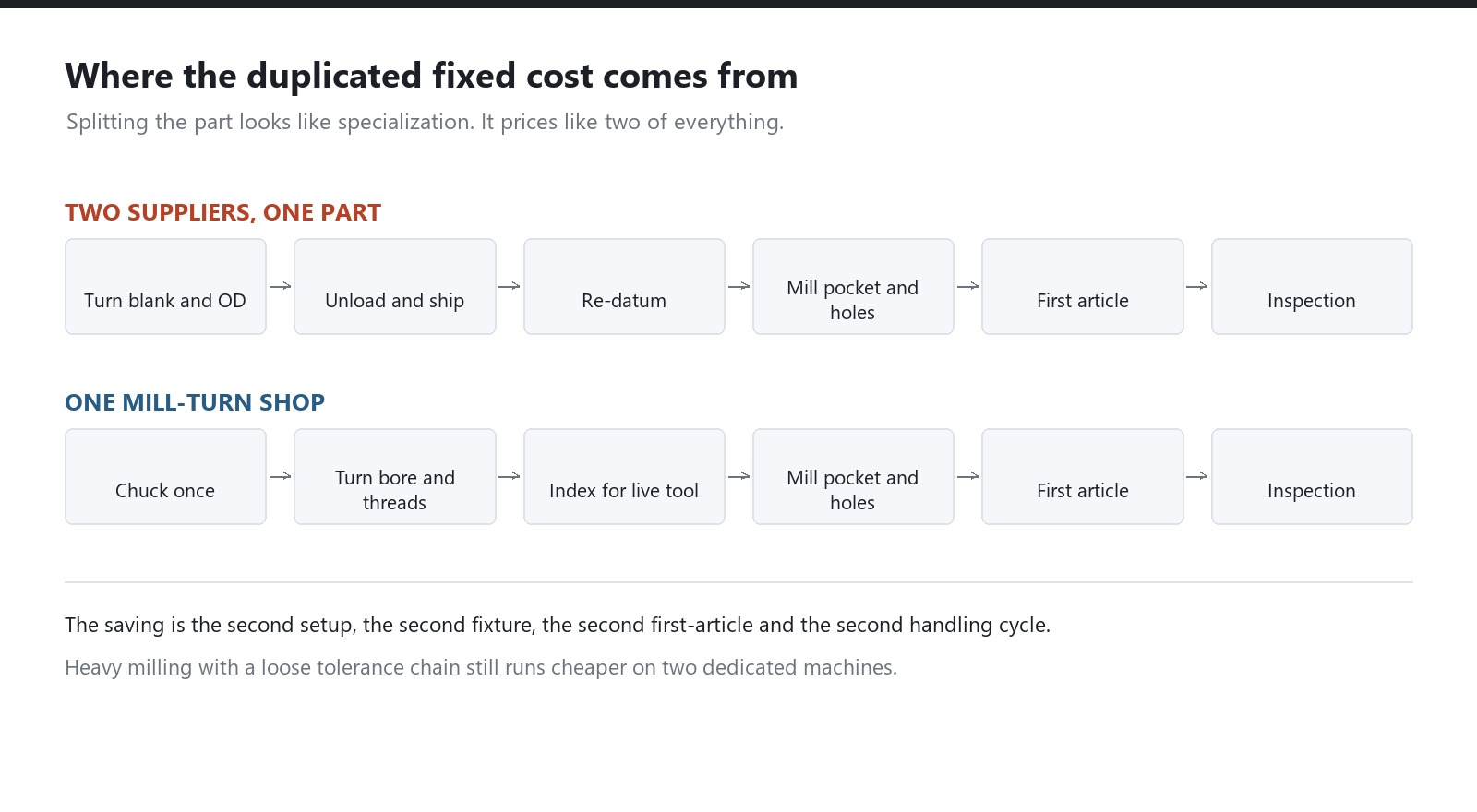
The two processes carry the same five inputs but weight them differently, which is why one part can be cheaper on a mill and a near-identical one cheaper on a lathe.
Turning holds a round workpiece in a chuck and brings a stationary tool to it. Setup is comparatively quick on simple round parts, and cycle time is short because the workpiece rotates continuously. A turned shaft with a few diameters and a thread is the least expensive geometry in machining.
Milling fixes the workpiece and moves a rotating cutter through it. Setup includes workholding that must resist cutting forces from multiple directions, and cycle time grows with the number of features because the tool must travel between them.
When a part has both turned and milled features, routing it through two processes pays two setup blocks and two first articles. A mill-turn machine that grips the part once can eliminate the second block entirely. The comparison of milling and turning covers the decision in more depth. For the cost view, the rule is simple: count the setups, not the processes.
Using a CNC machining cost calculator without being misled
A CNC machining cost calculator is only as good as the inputs behind it, and most public calculators take three: material, volume, and a complexity toggle.
That is enough to produce a range and not enough to produce a quote. The missing inputs are the ones that decide the outcome on real parts: how many setups, how tight the critical tolerance is, what inspection the drawing demands, and whether the shop has run the family before.
A calculator is useful for one thing. It gives a buyer a sanity band before the RFQ goes out, so an answer that lands far outside the band raises a question worth asking. It is not useful for negotiating, and treating a calculator output as a target invites a shop to quote to the target rather than to the part.
If you want a formula rather than a tool, the structure is this. Blank cost, divided by yield, plus cycle time multiplied by the loaded rate, plus setup hours divided by quantity, plus inspection and documentation, plus freight and packaging. Every term is knowable except the yield and the risk allowance, and those two are what a shop’s experience prices in.
The fuller working checklist for moving each term downward is in the article on how to reduce CNC machining costs without losing tolerance.
Conclusion
Three things are worth carrying away.
First, CNC machining cost is five inputs, not one rate. Name them and a quote becomes readable.
Second, the two inputs buyers can actually move are setup count and material choice. Both are decided on the drawing, months before the RFQ, and both are free to change at design stage.
Third, how to reduce CNC machining cost without touching quality comes down to the same two levers plus tolerance discipline. Tight where function needs it, general everywhere else, and never negotiate a rate when the hours are the real number.
If you have a drawing and a quantity and want the breakdown on your specific part, send it through the quote form. We return the inputs itemized rather than a single figure. The CNC machining services page lists process scope, About Us covers the shop, and the Blog Homepage carries the rest of this cluster.